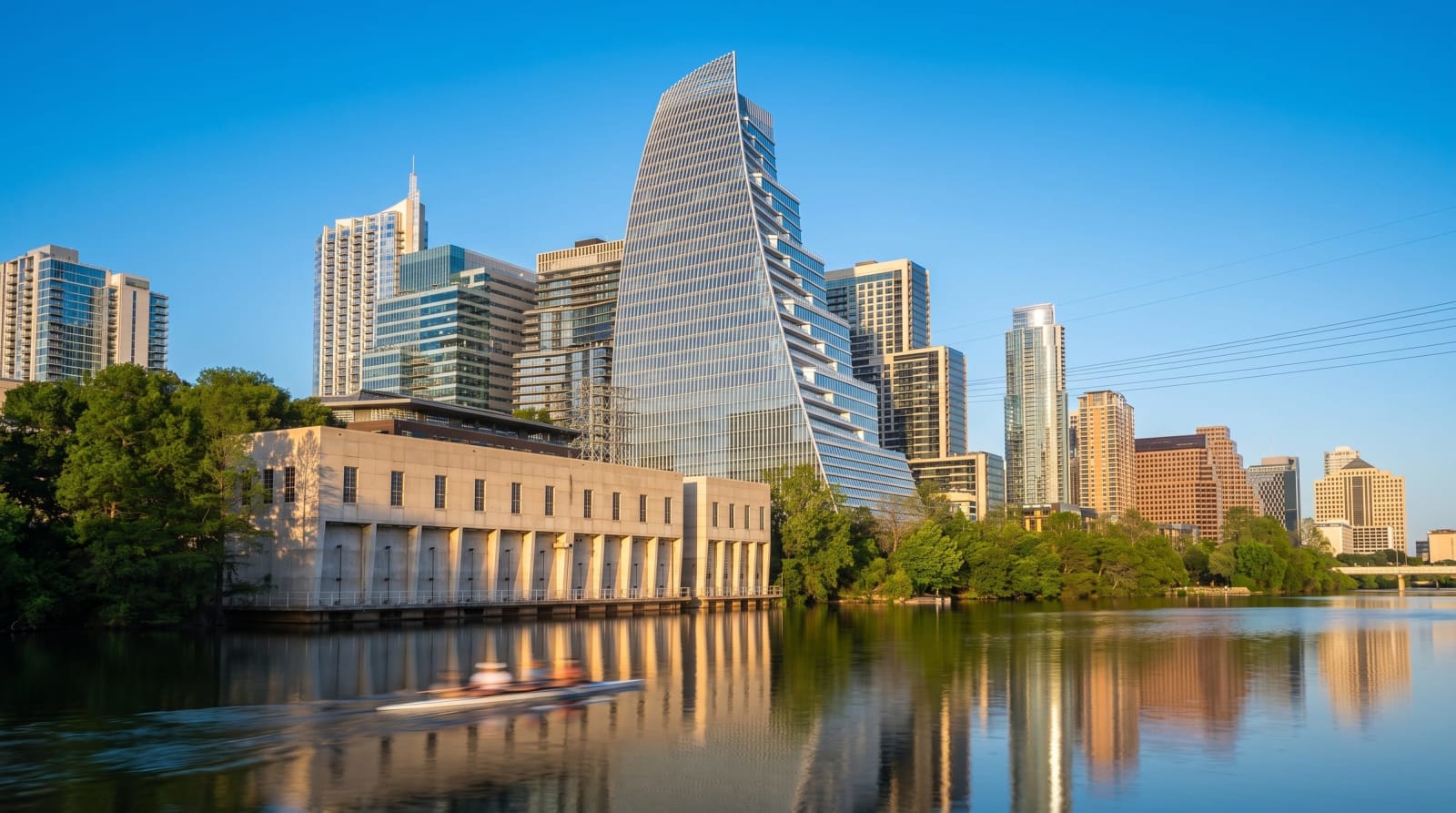
55+ Communities in Austin Area
Texas
Explore 6 active adult and retirement communities in Austin Area, Texas — with real photos, pricing, amenities, and resident insights for each.
Live Music Capital, tech hub, and Hill Country lakes with no state income tax — See why retirees are choosing the Austin Area
About Austin Area
The Austin area hits a distinct sweet spot for retirees who want big-city amenities, Hill Country scenery, and Texas's no-income-tax advantage in one metro. Anchored by Austin — the state capital and self-styled "Live Music Capital of the World" — the region stretches across Travis, Williamson, Hays, and Bastrop counties and includes fast-growing suburbs like Round Rock, Cedar Park, Pflugerville, Georgetown, Lakeway, Bee Cave, Dripping Springs, Buda, and Kyle. Texas has no state income tax, no estate tax, and no inheritance tax, so Social Security, pensions, IRA and 401(k) withdrawals are all untaxed at the state level — a genuine multi-thousand-dollar annual difference for most retirees compared with income-tax states.
Read moreShow less
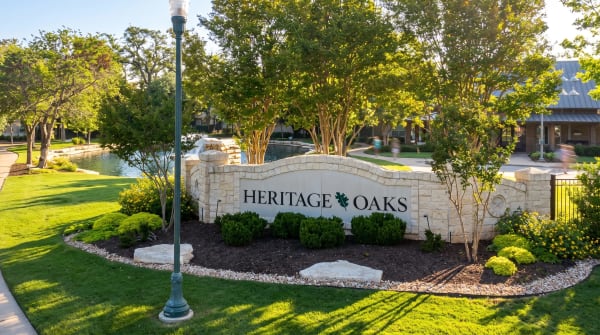
For 55+ buyers, the anchor community is Sun City Texas in Georgetown, about 30 miles north of downtown Austin. It's the largest active-adult community in Texas — 7,500+ homes built with roughly 10,000 planned at build-out, three 18-hole golf courses, four fitness centers, eight pools, over 100 clubs, and HOA dues around $1,200 a year. Resale homes start in the mid-$200,000s and run to $500,000+ for custom sections. Smaller age-restricted options include Heritage Oaks and The Oaks at Wildwood in Georgetown, and all-ages master-planned communities in Lakeway, Steiner Ranch, Avery Ranch, Bee Cave, and Dripping Springs give retirees who don't want an age restriction plenty of low-maintenance choices with resort-style amenities.
Sub-area character matters a lot here. Georgetown is the historic town-square, small-city retirement pick — Southwestern University, a walkable downtown, and Sun City nearby. Lakeway and Bee Cave along Lake Travis are the upscale Hill Country play, with lake access, wineries, and Baylor Scott & White Medical Center close by. Dripping Springs is the "Gateway to the Hill Country" — wineries, distilleries, and a slower pace 25 miles west of the city. Round Rock and Cedar Park sit closer to jobs, shopping, and the tech corridor for retirees who still want urban energy. Healthcare is a real strength across the metro: Ascension Seton (with Dell Seton Medical Center at UT — the region's Level I trauma center and only heart transplant program) and St. David's HealthCare are the two dominant systems, plus over 200 Ascension sites of care and a growing footprint of Baylor Scott & White facilities in the western suburbs.
The honest trade-offs are summer heat, traffic, and property taxes. Austin summers regularly hit triple digits from June through September, with August averaging a 97°F high; the UV index runs extreme, and the 2011 record hit 112°F. Interstate 35 is a chronic bottleneck, and the metro ranks around 15th nationally for traffic congestion. Property taxes are among the highest in the country because Texas funds services without an income tax — the median annual bill in Travis County runs about $10,823. Retirees who prioritize a lively cultural scene, lakes and Hill Country outdoors, world-class healthcare, and zero state tax on retirement income — and who can plan around the summer heat and property-tax reality — find Austin one of the strongest retirement metros in Texas.
Austin Area's cities, ranked for retirees
how we rank →From our Best Places rankings of every U.S. retirement city — cost of living modeled for a typical buyer, weather from 20 years of hourly data.
| City | US rank | Cost of living | Weather | 55+ residents |
|---|---|---|---|---|
| Georgetown | #17 | $3,408/mo | #295 of 858 | 37% |
| Round Rock | #58 | $3,368/mo | #306 of 858 | 21% |
| Leander | #158 | $3,378/mo | #284 of 858 | 18% |
| Austin | #258 | $4,273/mo | #339 of 858 | 20% |
| Cedar Park | #283 | $3,629/mo | #290 of 858 | 21% |
| Pflugerville | #390 | $3,297/mo | #307 of 858 | 20% |
Re-rank these around your own budget and ideal temps on the Texas rankings or across the entire US.
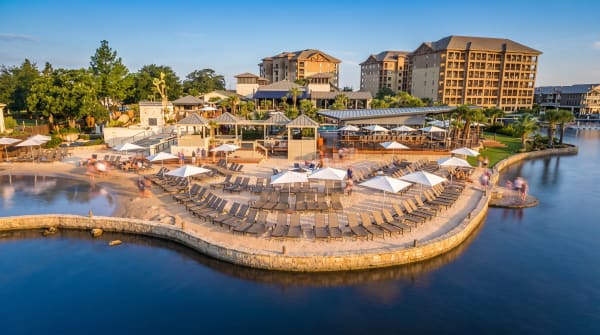
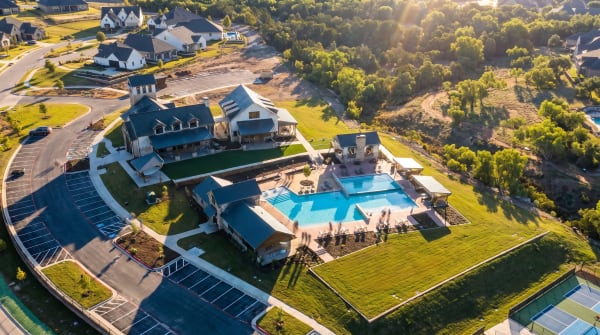
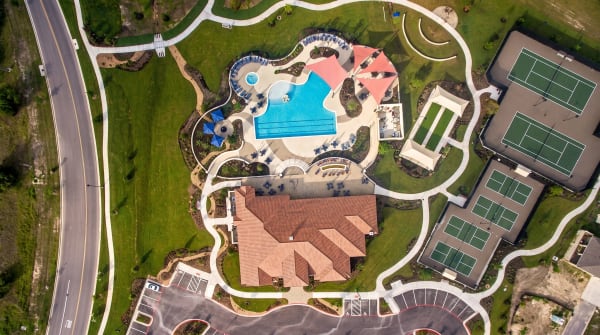
Browse 6 55+ communities in Austin Area
Open in browser →Click any community for a quick preview, or open the full page.

Pros of retiring here
- No state income tax
- No estate or inheritance tax at the state level
- $140,000 school homestead exemption plus additional over-65 exemption
- Over-65 school property tax ceiling freezes your school tax bill
- Austin-Bergstrom International Airport — 200+ daily flights, 75+ nonstop destinations
- Major healthcare systems — Ascension Seton and St. David's HealthCare
- Dell Seton Medical Center — Level I trauma and only heart transplant program in Central Texas
- Sun City Texas in Georgetown — largest 55+ community in Texas
- Hill Country lakes — Lake Travis, Lake Austin, Lady Bird Lake, Highland Lakes chain
- 50+ wineries in the Texas Hill Country
- Mild winters — January highs in the low 60s, virtually no snow
- 228 sunny days per year
- Live Music Capital of the World — deep arts, dining, and cultural scene
- Strong economy anchored by tech, University of Texas, and state government
- Insurance premiums lower than Gulf Coast Texas — no hurricane exposure
Things to consider
- Long, punishing summers — August average high 97°F, triple digits common June through September
- UV index regularly hits 11-12 (extreme)
- Central Texas hail corridor — 4-7 significant hail events per year drive up insurance
- CoreLogic ranks Austin the 5th most wildfire-exposed metro in the US
- Property taxes among the nation's highest — median Travis County bill about $10,823 a year
- High median home price — around $530,000 in Austin proper
- Traffic congestion — ranked 15th worst in the US, I-35 is a chronic bottleneck
- Rapid growth has strained infrastructure and driven up housing costs
- Severe spring thunderstorms and occasional tornadoes
- Periodic winter ice storms — 2021 grid failure is still fresh
- Homeowners insurance rising fast — carriers pulling back or non-renewing
- Sales tax up to 8.25% combined
- Limited public transit outside urban core
Cost of Living
The Austin area's cost of living lands roughly at or slightly above the national average overall, depending on which index you use — C2ER and Salary.com put Austin about 8-11% above the U.S. average, driven almost entirely by housing, while RentCafe shows the metro a few percent below the national average when suburbs are included. The honest read: Austin proper is expensive, but the surrounding suburbs (Georgetown, Round Rock, Cedar Park, Kyle, Buda) bring the metro-wide picture much closer to national norms.
Housing is the headline number. The median home price in Austin sits around $530,000 to $577,000, well above the U.S. median of roughly $338,000, though the market has cooled from its 2021-2022 peak. Suburb prices run meaningfully lower — Williamson County (Round Rock, Cedar Park, Georgetown) median around $410,000, and Hays County (Kyle, Buda, San Marcos) around $350,000-$370,000. A one-bedroom apartment in Austin averages roughly $1,500 a month; two-bedrooms around $1,900. Groceries, healthcare, and utilities all run within a few percent of national averages, with healthcare often 10% below and entertainment/personal care about 8% below (RentCafe).
Retiree Specific Texas has no state income tax, so Social Security benefits, pensions, IRA and 401(k) withdrawals, capital gains, and dividends are all untaxed at the state level. There is no state estate tax and no inheritance tax. The trade-off is property tax: Texas has one of the highest average effective property tax rates in the country, roughly 1.8% statewide and 2.07% in Travis County (Austin proper), with a median annual bill around $10,823 on a $515,000 taxable homestead. Williamson County suburbs run closer to 1.68% combined; Hays County around 1.85-2.20%. Texas does offer real senior relief: every homestead gets a $140,000 school-district exemption (approved Nov 2025), plus an additional exemption for owners 65 and older, and an over-65 school-tax ceiling that freezes the school portion of your bill at the amount owed the year you turn 65. Deferrals are also available for seniors who want to postpone property tax payment. Combined state and local sales tax is up to 8.25%.
Additional Considerations Homeowners insurance has climbed sharply. Austin sits in one of the most active hail corridors in the U.S. — 4-7 significant hail events per year — and Central Texas is now scored for wildfire risk in Travis, Hays, and Williamson counties. Expect roughly $2,200-$3,500 a year for a standard policy on a $300,000-$400,000 home, with percentage-based wind and hail deductibles (1-2% of dwelling value) now standard. That is cheaper than Houston (~$6,300/yr) or Dallas-Fort Worth (~$3,800-$5,000/yr) but well above the national average. Farmers and AAA have limited new policies in Texas, reducing competition. Newer suburban communities often sit inside Municipal Utility Districts (MUDs) or Emergency Services Districts that add to the base property-tax rate — verify total effective rate before you buy. Electricity bills spike in summer when air conditioning runs continuously from June through September, and Texas's independent power grid (ERCOT) has been vulnerable to both extreme cold (February 2021) and extreme heat events.
Notable places in and around Austin Area
1 signature destinations within 75 miles
Other 55+ regions in Texas
Where is Austin Area?
- Cities:
- Austin, Round Rock, Cedar Park, Leander, Pflugerville, Georgetown, Lakeway, Bee Cave, Dripping Springs, Buda, Kyle, Taylor, Liberty Hill, Hutto, Bastrop
- Counties:
- Travis County, Williamson County, Hays County, Bastrop County
- ZIP codes:
- 78701, 78702, 78703, 78704, 78705, 78721, 78722, 78723, 78724, 78725, 78726, 78727, 78728, 78729, 78730, 78731, 78732, 78733, 78734, 78735, 78736, 78737, 78738, 78739, 78741, 78745, 78746, 78747, 78748, 78749, 78750, 78752, 78753, 78754, 78756, 78757, 78758, 78759, 78664, 78665, 78613, 78641, 78660, 78626, 78628, 78633, 78620, 78610, 78640
55+ communities in Austin Area: common questions
How many 55+ communities are in Austin Area?
There are 6 active adult and 55+ communities in Austin Area featured on Explore55Plus, with real photos, pricing, amenities, and resident insights for each.
How much do homes in 55+ communities in Austin Area cost?
Homes in retirement and active adult communities in Austin Area range from $200K to $1M, depending on the community, home type, and whether it's a new build or resale.
Are all 55+ communities in Austin Area age-restricted?
No. Of the 6 communities in Austin Area, 5 are age-restricted (typically one resident 55+) and 1 is open to all ages — so you can choose either an age-restricted or an all-ages active adult community.
Are there new-construction 55+ communities in Austin Area?
Yes — 4 of the 6 communities in Austin Area have new-construction homes available, alongside resale options in established neighborhoods.