
55+ Communities in Indianapolis Area
Indiana
Explore 12 active adult and retirement communities in Indianapolis Area, Indiana — with real photos, pricing, amenities, and resident insights for each.
Big-city amenities with Midwest affordability & top-ranked suburbs like Carmel and Fishers — See why retirees are choosing the Indianapolis Area
About Indianapolis Area
The Indianapolis Area hits a rare sweet spot for retirees who want real city amenities without a coastal price tag. Indiana doesn't tax Social Security, the state's flat income tax is dropping to 2.95% in 2026 (and scheduled to fall to 2.90% in 2027), and there's no state estate or inheritance tax — which means most retirees keep more of their pension, 401(k), and IRA withdrawals than they would in almost any neighboring state. Property taxes are capped at 1% of assessed value for homesteads, and the Standard Homestead Deduction knocks $48,000 off assessed value before the supplemental 40% deduction is even applied. For a retiree comparing Indianapolis against Nashville, Chicago, or Charlotte, the tax math is genuinely persuasive.
Read moreShow less
The 55+ community landscape is one of the deepest in the Midwest. The action is concentrated in the north-side Hamilton County suburbs — Carmel, Fishers, Westfield, Noblesville, Zionsville — where you'll find resort-style developments like Britton Falls (Del Webb, Fishers), Finch Creek by Del Webb (Noblesville), Osborne Trails (Westfield), and Heritage at Spring Mill (Carmel), plus a growing rental crop including GrandView 55+ Living in Westfield and Fishers Run. West-side buyers gravitate to Vandalia by Del Webb in Plainfield near IU Health West Hospital, and Sagebriar by Del Webb anchors Greenwood on the south side. Hamilton County suburb medians run $420,000–$470,000 (Carmel closer to $630,000 for new luxury builds), while Indianapolis proper sits around $270,000 — a real range that lets retirees dial in their price point without leaving the metro.
Healthcare is a genuine strength. The area is anchored by five major systems — Indiana University Health, Ascension St. Vincent, Franciscan Health, Community Health Network, and Eskenazi Health — with Ascension St. Vincent's 840-bed flagship on 86th Street operating a Level I trauma center, comprehensive stroke center, burn center, and transplant center. Ascension St. Vincent Carmel and Fishers put full hospitals in the north suburbs, and Rehabilitation Hospital of Indiana is a joint IU Health/Ascension venture for stroke, brain injury, and orthopedic recovery. Indianapolis International Airport (IND) is consistently ranked among the best mid-size airports in North America, making family visits and getaways easy.
The trade-off, honestly, is the weather. Winters are cold — January averages drop into the low-20s at night — and the area sits in a corridor where spring and fall tornado watches are a real (if usually manageable) part of the calendar. But summers are green and long, fall foliage is legitimate, and the Monon Trail runs 20+ miles from Sheridan through Westfield, Carmel, and Broad Ripple into downtown Indy — a rails-to-trails spine that a lot of retirees actually use for daily walking and cycling. Carmel's Arts & Design District, the Palladium concert hall, professional sports (Colts, Pacers, Fever, Indianapolis Indians), the Indy 500, and one of the country's best downtowns round out a lifestyle that's more culturally serious than most people expect from the Midwest.
Indianapolis Area's cities, ranked for retirees
how we rank →From our Best Places rankings of every U.S. retirement city — cost of living modeled for a typical buyer, weather from 20 years of hourly data.
| City | US rank | Cost of living | Weather | 55+ residents |
|---|---|---|---|---|
| Greenwood | #110 | $2,873/mo | #596 of 858 | 27% |
| Carmel | #184 | $3,230/mo | #619 of 858 | 28% |
| Noblesville | #219 | $2,980/mo | #614 of 858 | 23% |
| Fishers | #272 | $3,008/mo | #616 of 858 | 23% |
| Anderson | #309 | $2,469/mo | #632 of 858 | 32% |
| Indianapolis | #495 | $2,796/mo | #595 of 858 | 24% |
Re-rank these around your own budget and ideal temps on the Indiana rankings or across the entire US.
Browse 12 55+ communities in Indianapolis Area
Open in browser →Click any community for a quick preview, or open the full page.
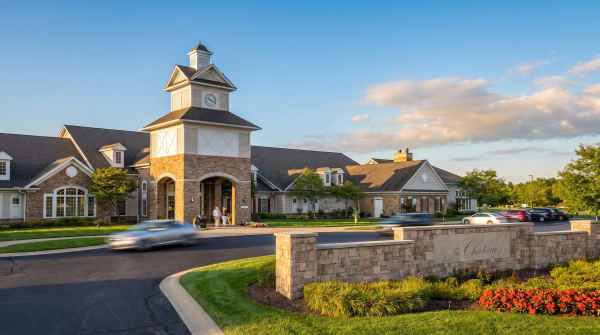 55+
55+Britton Falls
Indianapolis Area
$250K – $550K
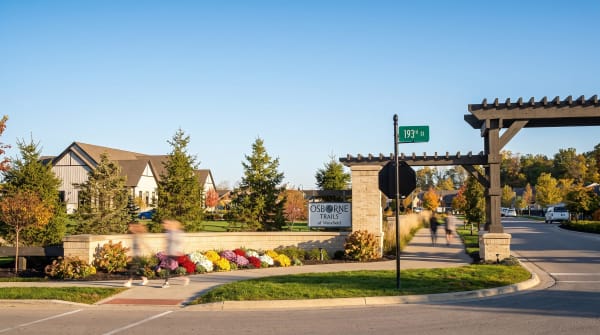 55+
55+Osborne Trails
Indianapolis Area
$300K – $550K
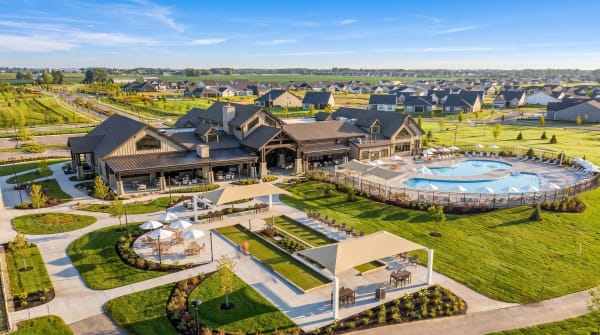 55+
55+Finch Creek by del Webb
Indianapolis Area
$300K – $550K
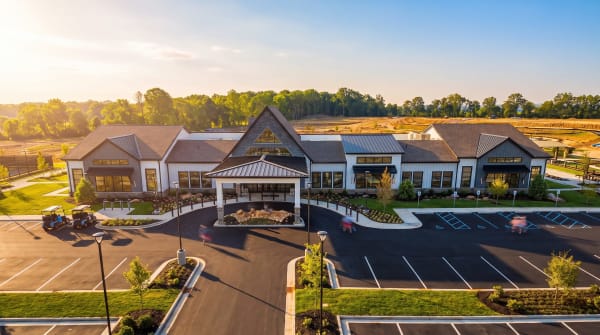 55+
55+Sagebriar by del Webb
Indianapolis Area
$300K – $450K
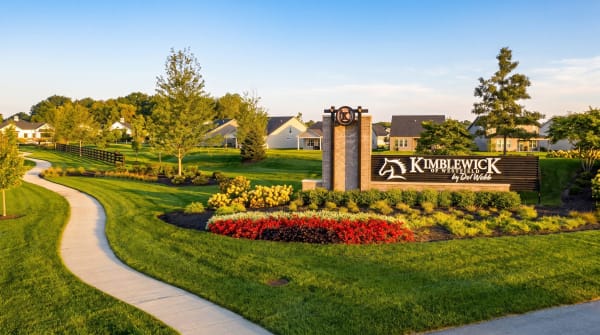 55+
55+Kimblewick
Indianapolis Area
$400K – $850K
Village at New Bethel
Indianapolis Area
$250K – $400K
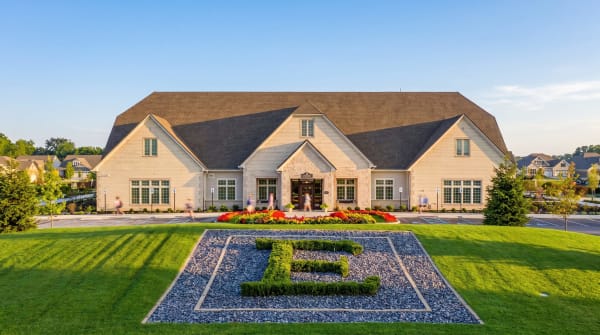 55+
55+Easton
Indianapolis Area
$300K – $700K
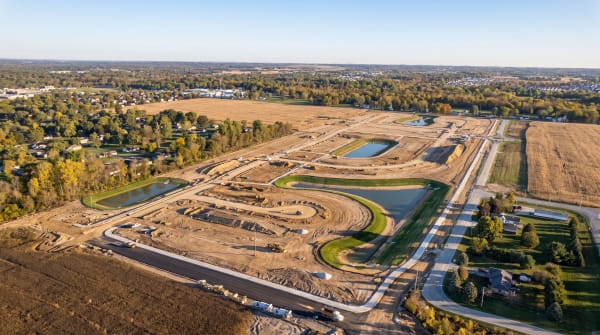 55+
55+Easton 2
Indianapolis Area
$350K – $500K
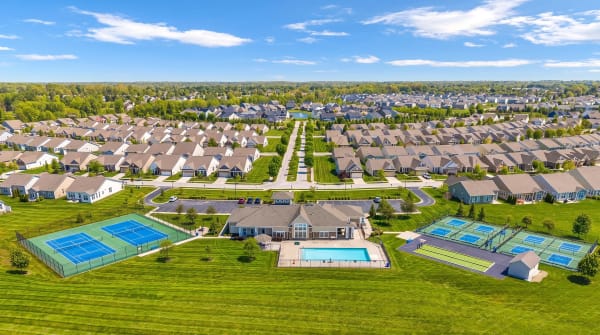 55+
55+Vandalia by Del Webb
Indianapolis Area
$300K – $450K
 55+
55+Gatherings at Aurora
Indianapolis Area
$400K – $450K
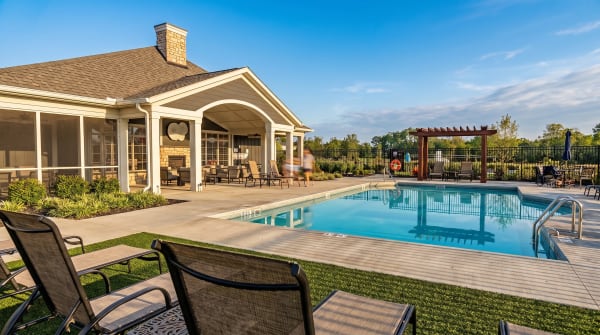 55+
55+The Courtyards of Carmel
Indianapolis Area
$450K – $800K
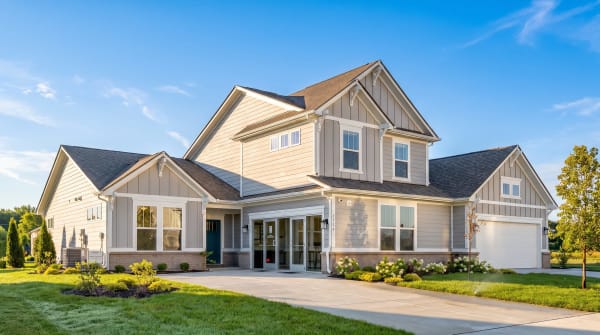
Reserve at Rocklane Ridge
Indianapolis Area
$300K – $400K
Pros of retiring here
- No state tax on Social Security
- Flat state income tax dropping to 2.95% in 2026 (2.90% in 2027)
- No state estate or inheritance tax
- 1% property tax cap on homesteads
- $48,000 Standard Homestead Deduction plus 40% supplemental
- Over-65 Circuit Breaker caps annual property tax increase at 2%
- Military retirement fully exempt from state income tax
- Deep 55+ community options — Del Webb, Epcon, HighGround, and more
- Major international airport — IND
- Strong healthcare — IU Health, Ascension St. Vincent, Franciscan, Community
- Median home prices well below the national average
- Carmel and Fishers regularly ranked among America's best places to live
- Monon Trail and Cultural Trail for walking and cycling
- Four real seasons with legitimate fall foliage
- Pro sports (Colts, Pacers, Fever) plus Indy 500 and Brickyard
- Chicago, Louisville, Cincinnati, and St. Louis all within 3–5 hours
Things to consider
- Cold winters — January lows in the low-20s and periodic heavy snow
- Sits in the spring/fall tornado corridor of the Midwest
- Hot, humid, thunderstorm-heavy summers
- Pensions, 401(k), and IRA withdrawals are taxed (unlike SS)
- County income taxes stack 0.5–3% on top of the state rate
- Sales tax is 7% — higher than the national average
- Carmel and Zionsville home prices push well above metro median
- Limited public transit outside the urban core
- Marion County (Indianapolis proper) has pockets with higher crime
- Spring tends to be the wettest and most storm-prone season
Cost of Living
The Indianapolis Area lands roughly 7–11% below the national average overall depending on the index, with housing doing most of the heavy lifting. AreaVibes puts the housing index about 15% below the national average, RentCafe puts Indianapolis housing 24% below, and Apartments.com pegs it at 23% below. The median home sale price across Central Indiana was $325,000 in mid-2026 (MIBOR), well under the U.S. average — but there's enormous range inside the metro: Indianapolis proper runs around $269,900, Fishers around $460,000, Noblesville around $450,000, Westfield around $520,000, and Carmel around $629,000. Zionsville tops the metro at roughly $1.08M. Utilities run about 6–10% below the national average, healthcare about 13–15% cheaper, and groceries essentially at the national average. Average monthly rent sits around $1,266, well under the U.S. average of $2,102.
Retiree Specific: Indiana does not tax Social Security benefits at the state level. Other retirement income — pensions, 401(k) withdrawals, traditional IRA distributions — is taxed at Indiana's flat rate, which was 3.05% in 2025, dropped to 2.95% for tax year 2026, and is scheduled to fall to 2.90% in 2027. Military retirement pay is fully exempt at age 60 and older. Indiana has no state estate tax and no inheritance tax. Property taxes are among the more retiree-friendly in the country: the effective statewide rate is roughly 0.74–0.85%, homesteads get a $48,000 Standard Deduction plus a 40% Supplemental Deduction, and there's a hard 1% cap on homestead property tax as a share of assessed value. Starting tax year 2026, all qualifying homesteads receive an automatic 10% credit on their property tax bill (up to $300). The Over-65 Circuit Breaker Credit caps annual property tax increases at 2% for qualifying seniors (income limits apply — $30,000 single / $40,000 joint AGI). There's also an Over-65 Credit worth $150 for seniors with AGI under $60,000 single / $70,000 joint. Combined state and average local sales tax is about 7%, and groceries are exempt.
Additional Considerations: Indiana's county income taxes stack on top of the state rate — most counties in the metro add 0.5% to 3%, so your actual all-in state-and-local income tax depends on which county you settle in (Marion, Hamilton, Hendricks, Johnson, and Boone all have different rates). Insurance is generally moderate compared to coastal states, but severe weather does drive higher wind and hail premiums in some years. Newer 55+ developments in Fishers, Westfield, Noblesville, and Plainfield often carry HOA fees for amenities, private roads, and lawn/snow maintenance — a real budget line for retirees who don't want to shovel. Utility costs skew toward heating in winter and moderate summer cooling, and winter road salt is a genuine consideration for cars if you're coming from a sunbelt state.
Where is Indianapolis Area?
- Cities:
- Indianapolis, Carmel, Fishers, Noblesville, Westfield, Zionsville, Brownsburg, Avon, Plainfield, Greenwood, Franklin, McCordsville, Pendleton, Anderson
- Counties:
- Marion County, Hamilton County, Hendricks County, Johnson County, Hancock County, Madison County, Boone County
- ZIP codes:
- 46201, 46202, 46204, 46205, 46208, 46217, 46219, 46220, 46226, 46227, 46228, 46234, 46236, 46237, 46239, 46240, 46250, 46254, 46256, 46260, 46268, 46032, 46033, 46037, 46038, 46060, 46074, 46077, 46112, 46123, 46142, 46168, 46131, 46055, 46064, 46016
55+ communities in Indianapolis Area: common questions
How many 55+ communities are in Indianapolis Area?
There are 12 active adult and 55+ communities in Indianapolis Area featured on Explore55Plus, with real photos, pricing, amenities, and resident insights for each.
How much do homes in 55+ communities in Indianapolis Area cost?
Homes in retirement and active adult communities in Indianapolis Area range from $250K to $850K, depending on the community, home type, and whether it's a new build or resale.
Are all 55+ communities in Indianapolis Area age-restricted?
No. Of the 12 communities in Indianapolis Area, 10 are age-restricted (typically one resident 55+) and 2 are open to all ages — so you can choose either an age-restricted or an all-ages active adult community.
Are there new-construction 55+ communities in Indianapolis Area?
Yes — 8 of the 12 communities in Indianapolis Area have new-construction homes available, alongside resale options in established neighborhoods.