
The Best Places to Retire in Oklahoma
8 cities ranked · 1 community across 1 region
Every Oklahoma retirement city, scored on 20 years of hourly weather, an itemized cost of living, and a happiness index built from federal data — then re-ranked live around your budget and ideal temperatures. When a city clicks, explore the 55+ communities inside it.
Oklahoma's cities, ranked for retirees
Updated August 25, 2026 · how we rank →
8 cities across Oklahoma · ranked for a typical buyer
Found a place you like?
Create a free account to explore the 55+ communities inside these cities — photos, pricing, amenities, and a matching quiz.
Retiring in Oklahoma
Oklahoma sits at the crossroads of the South, the Great Plains, and the Southwest, and that mixed character shows up in its retirement pitch: friendly, unpretentious, and genuinely affordable, with wide-open country, wooded hills in the east, and lakes almost everywhere you look. For most 55+ buyers weighing retiring in Oklahoma, the decision comes down to two metros and the lake country between them.
Read moreShow less
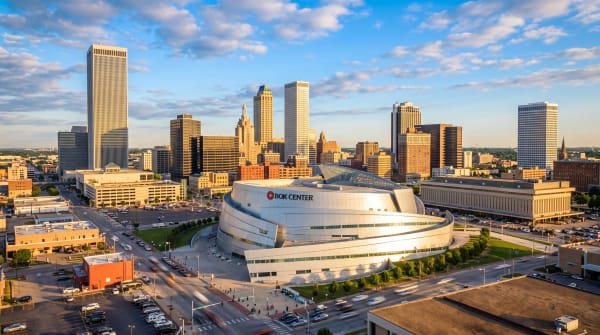
The Oklahoma City metro anchors the center of the state. Edmond to the north draws retirees who want top-tier suburban polish, walkable parks like Mitch Park, and quick access to INTEGRIS Baptist and OU Health hospital systems. Norman offers a college-town rhythm with the University of Oklahoma, lifelong learning programs, and Lake Thunderbird nearby. Moore consistently ranks near the top of national lists of best places to retire in Oklahoma for its household-income and safety scores. To the northeast, the Tulsa metro is greener and hillier, with strong arts and museums in town and highly-rated suburbs (Broken Arrow, Bixby, Jenks, Owasso) offering active adult and independent living inventory at prices well below comparable Tulsa neighborhoods. Broken Arrow's Rose District has become a real downtown destination.
Beyond the metros, the lakes carry the retirement traffic. Grand Lake o' the Cherokees in the northeast is a longtime second-home and retirement destination with marinas and golf. Lake Texoma along the Red River pulls buyers who want fishing, boating, and a short drive to Dallas-Fort Worth. Small cities like Bartlesville, Guthrie, and Claremore round out the map for retirees who want a slower, more historic setting.
The honest answer to "is Oklahoma a good place to retire?" is that it depends on what you're optimizing for. If you want your dollar to stretch (a comfortable single-story home, a tax picture that's genuinely kind to retirees, and neighbors who still wave), Oklahoma is one of the strongest values in the country. If you need mountain scenery, ocean access, or a giant master-planned Sun City-scale campus, this isn't your state. The active adult communities and retirement communities in Oklahoma suit people who care more about affordability, family proximity, and a warm, down-to-earth pace than about living inside a resort.
Explore Oklahoma by region
Dive into 55+ communities by region — each guide covers local amenities, pricing, and what makes the area a fit for retirees.
Taxes for retirees in Oklahoma
Oklahoma is genuinely retiree-friendly on taxes. For the 2025 tax year the state uses a six-bracket graduated income tax topping out at 4.75%, and lawmakers have repeatedly floated further cuts, including a 2026 restructure. Social Security benefits are fully exempt from Oklahoma income tax regardless of income level. Residents 65 and older get a $10,000-per-person retirement income exclusion that applies to pensions, IRA withdrawals, 401(k) distributions, and annuities. A married couple can shelter $20,000 a year of retirement withdrawals before the state takes anything. Military retirement pay is fully exempt (or 75% of retirement income, whichever is greater), and federal civil service pensions in lieu of Social Security are also fully deductible.
Property taxes are among the lowest in the nation. The effective statewide rate runs around 0.85-0.9%, and the median Oklahoma homeowner pays roughly $1,672 a year, about half the national median. Homeowners get a standard $1,000 homestead exemption off assessed value. Residents 65 and older with household income at or below the county HUD median (currently $90,300 for the 2026 property tax year in Tulsa and Oklahoma counties, up from $89,500 the prior year) can file OTC Form 994 with their county assessor for a Senior Valuation Freeze that locks in the taxable fair cash value against future increases. Lower-income seniors under $30,000 can claim an Additional Homestead Exemption that doubles the standard exemption to $2,000. Both are filed between January 1 and March 15.
Oklahoma has no estate tax and no inheritance tax. The one place the state is not cheap is sales tax: the 4.5% state rate is low, but local additions push combined rates to roughly 9% on average and as high as 11% in some cities, and groceries are taxed at the full combined rate. Confirm current income limits and bracket numbers with a local assessor or tax professional before you count on them.
Oklahoma climate & weather
Oklahoma has four real seasons. Summers are hot and often humid, with long stretches in the 90s and a handful of 100-degree days. Winters are relatively mild compared to the northern Plains, with cold snaps, occasional ice storms, and modest snowfall but few sustained deep freezes. Spring and fall are the standout seasons, green, comfortable, and pleasant, though they come with the strong, persistent winds the Plains are known for year-round.
The honest trade-off is severe weather. Oklahoma sits in the heart of Tornado Alley and averages roughly 59 tornadoes a year, more than any other state, with 2024 setting a record 151. Spring storm season also brings the country's most damaging hail, and hail (not tornadoes) is what's driving the state's insurance crisis. Most Oklahomans build storm shelters into their routine. The state's SoonerSafe program offers rebates of up to $3,000 for FEMA-approved safe rooms, but it's a real factor to weigh, and it costs real money on your insurance bill (see Cost of Living).
Cost of living in Oklahoma
Oklahoma runs about 12-13% below the national average on overall cost of living, consistently ranking among the most affordable states in the country. Housing is the headline. The statewide median home price sits around $236,700 (Bankrate, 2025). Zillow's typical home value runs closer to $217,000, versus a U.S. median north of $428,000. In Oklahoma City, the median sale price is roughly $265,000-$280,000; Edmond runs $345,000-$395,000 for its top-tier suburban stock; Broken Arrow around $283,000; smaller cities and lake towns land well below the state median. The effective property tax rate is around 0.85-0.9%, among the lowest in the nation.
Read moreShow less
Everyday expenses run below national averages across the board. RentCafe pegs housing 27% below the U.S. average, utilities 4% lower, groceries 4% lower, and healthcare services roughly 9% lower. Oklahoma gas prices consistently run 15-25% under national averages. The typical Oklahoma City household needs about $71,500 in annual income to afford the median home, versus roughly $117,000 nationally. That gap is the whole retiree-relocation story in one number.
Social Security stretches further here than almost anywhere. Healthcare is solid in both metros (INTEGRIS, OU Health, and Mercy in the OKC metro; Ascension St. John and Saint Francis in Tulsa), though rural counties and lake communities can mean 30- to 60-minute drives for specialized care. Medicare Advantage networks are strong in the metros and thinner in rural counties.
The honest caveat is homeowners insurance. Oklahoma is now the second-most-expensive state in the country for home insurance, with average premiums projected around $5,858 in 2026, nearly double the national average, and up roughly 24% in 2025 alone. Hail, not tornadoes, is doing most of the damage. Most Oklahoma policies also carry a percentage-based wind-and-hail deductible of 1-5% of dwelling value, so on a $300,000 home a 2% wind deductible is $6,000 out of pocket before coverage kicks in for storm damage. Budget for it, because it partially offsets the state's low property taxes and cheap home prices.
Pros of retiring in Oklahoma
- Cost of living runs about 12-13% below the national average
- Statewide median home price around $236,700, less than half the U.S. median
- No state tax on Social Security benefits, at any income level
- $10,000-per-person retirement income exclusion for pensions, IRAs, and 401(k)s at age 65+
- Military retirement pay fully exempt from state income tax
- Graduated state income tax tops out at just 4.75% for 2025
- Property tax effective rate around 0.85%, among the lowest in the nation
- Senior Valuation Freeze locks in a home's taxable value for qualifying homeowners 65+ (HUD income limit ~$90,300)
- No estate tax and no inheritance tax
- Strong healthcare in the OKC and Tulsa metros (INTEGRIS, OU Health, Mercy, Ascension St. John, Saint Francis)
- Abundant lakes (Grand Lake, Lake Texoma, Lake Thunderbird, Keystone) for boating and fishing
- Relatively mild winters compared to the northern Plains
- Friendly, unpretentious communities with a slower pace and low cost of everyday life
- Central location with easy access to Dallas-Fort Worth and OKC's Will Rogers World Airport
- SoonerSafe program offers rebates up to $3,000 toward FEMA-approved storm shelters
Things to consider
- Homeowners insurance is the second-highest in the nation, projected at ~$5,858/year in 2026, more than double the national average
- Insurance rates jumped roughly 24% in 2025 alone, and most policies carry a 1-5% wind and hail deductible
- More tornadoes than any other state, averaging 59 a year, with 151 in 2024
- Spring storm season brings damaging hail, straight-line winds, and severe thunderstorms
- Hot, humid summers with long stretches in the 90s
- Persistent, strong Plains winds nearly year-round
- Combined sales tax averages around 9% and hits groceries, one of the higher effective burdens in the country
- Fewer large master-planned 55+ campuses than Arizona, Florida, or Texas
- Rural areas and lake communities can mean long drives for specialized healthcare
- Limited public transit. A car is essential outside the two metro cores
55+ communities in Oklahoma: common questions
How many 55+ communities are in Oklahoma?
There is 1 active adult and 55+ community in Oklahoma featured on Explore55Plus, with real photos, pricing, amenities, and resident insights for each.
How much do homes in 55+ communities in Oklahoma cost?
Homes in retirement and active adult communities in Oklahoma range from $400K to $900K, depending on the community, home type, and whether it's a new build or resale.
Are 55+ communities in Oklahoma age-restricted?
Yes — the 55+ communities in Oklahoma featured here are age-restricted, generally requiring at least one resident to be 55 or older.
Are there new-construction 55+ communities in Oklahoma?
Yes — 1 of the 1 communities in Oklahoma has new-construction homes available, alongside resale options in established neighborhoods.