
The Best Places to Retire in New Mexico
5 cities ranked · 3 communities across 1 region
Every New Mexico retirement city, scored on 20 years of hourly weather, an itemized cost of living, and a happiness index built from federal data — then re-ranked live around your budget and ideal temperatures. When a city clicks, explore the 55+ communities inside it.
New Mexico's cities, ranked for retirees
Updated August 25, 2026 · how we rank →
5 cities across New Mexico · ranked for a typical buyer · 1 demoted over your $375k home budget
Found a place you like?
Create a free account to explore the 55+ communities inside these cities — photos, pricing, amenities, and a matching quiz.
Retiring in New Mexico
New Mexico is the Southwest's quieter, cheaper, stranger cousin. It's the state worth considering when Arizona feels overbuilt and Colorado has priced you out. Retirees come for high-desert sunshine, four real (mild) seasons at altitude, a Pueblo-Spanish-Anglo culture that exists nowhere else in the country, and one of the more tax-friendly setups for middle-income households. It's also a state with a genuine doctor shortage, a serious wildfire problem, and crime numbers that outpace the national average, the kind of honest trade-offs that don't appear in the tourism brochures.
Read moreShow less
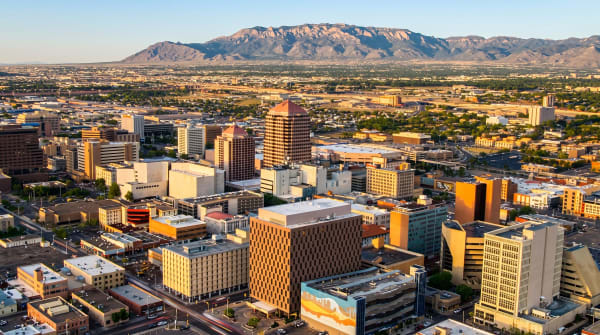
Most retiree attention lands in a handful of places. Albuquerque and neighboring Rio Rancho and Corrales offer the state's full urban infrastructure (a major airport, UNM Hospital and Presbyterian, big-box retail, museums) at prices well below Denver or Phoenix. Santa Fe, at 7,000 feet, is the arts-and-adobe capital where the culture is dense and the real estate is not; home prices there run close to double Albuquerque's. Las Cruces in the south trades altitude for warmth, with an affordable cost of living, New Mexico State University culture, and El Paso's medical infrastructure an hour away on the highway. Smaller options like Silver City, Ruidoso, Taos, and Truth or Consequences suit retirees who want small-town affordability and are comfortable driving for specialty care.
The money story is straightforward: property taxes are among the lowest in the nation, there is no estate or inheritance tax, Social Security is exempt for most retirees below $100,000 single or $150,000 joint, and military retirement pay gets a $30,000 exemption. Pensions and IRA/401(k) withdrawals are taxed at graduated rates from 1.5% to 5.9%, which stings large-drawdown portfolios but is mild for the typical retiree. The climate story is elevation: nearly everywhere you'd live sits between 3,500 and 7,500 feet, which means intense sun, dry air, cool nights, real winters in the north, and warm-but-not-Florida summers.
For an active, culturally curious retiree with a moderate income who can accept dry air, high altitude, and a healthcare system under strain, New Mexico is one of the better values in the West. For someone who needs constant specialist access, humidity for arthritis, or a low-crime backdrop, look harder before you commit.
Explore New Mexico by region
Dive into 55+ communities by region — each guide covers local amenities, pricing, and what makes the area a fit for retirees.
Taxes for retirees in New Mexico
New Mexico ranks among Kiplinger's most tax-friendly states for retirees, and the specifics back that up for middle-income households. Social Security is fully exempt from state income tax when adjusted gross income is under $100,000 for single filers, $150,000 for joint filers, or $75,000 for married-filing-separately, thresholds indexed to inflation in 2023 so they rise each year. Above those lines, Social Security becomes taxable in full, a cliff that makes withdrawal sequencing and Roth conversions unusually valuable here. State income tax runs across six brackets from 1.5% to 5.9%, with the top rate applying to income above $210,000 single or $315,000 joint. Pensions, IRA withdrawals, and 401(k) distributions are all taxed as ordinary income, though residents 65 and older can deduct up to $8,000 of retirement income if household income is modest. The deduction phases out entirely above roughly $28,500 single or $51,000 joint. Military retirement pay gets a separate $30,000 exemption through tax year 2026, and disabled-veteran pay is fully exempt.
The estate side is clean: New Mexico levies neither an estate tax nor an inheritance tax. Property taxes are the other headline number, with the effective rate running around 0.72% to 0.80% of value, well below the national average. Low-income homeowners age 65 and older can freeze the assessed value of their primary residence under NMSA §7-36-21.3 once modified gross income falls below the annual limit ($44,200 for the 2026 cycle). The freeze locks the valuation, not the mill rate, so bills can still creep up if local rates rise. A separate low-income property-tax rebate of up to $250 is available to homeowners 65 and older with income at or below $16,000, and a $2,000 head-of-family exemption reduces taxable value further.
On the consumption side, New Mexico technically imposes a gross receipts tax rather than a sales tax, but consumers feel it the same way. The state rate is 4.875%, and local add-ons bring the combined rate to an average of about 7.63%, roughly average nationally. Most groceries are exempt; prepared food is not. Capital gains are taxed as ordinary income with a standard $2,500 deduction, larger for sales of a New Mexico business.
New Mexico climate & weather
New Mexico's climate is defined by elevation, not latitude. Average elevation is about 4,700 feet, and temperatures drop roughly 5°F for every 1,000 feet you climb. Albuquerque at 5,300 feet averages 280 sunny days a year and gets just 11 inches of annual rainfall. Santa Fe at 7,000 feet gets 283 sunny days, 15 inches of rain, and a real winter with January lows near 20°F and occasional snowstorms. Las Cruces and the southern Rio Grande Valley sit lower and warmer. The extreme southeast averages 64°F year-round and stays comfortable in winter, though summer highs push into the mid-90s. The whole state is semi-arid with low humidity, cool nights, monsoon thunderstorms in July and August, and enough spring wind to be its own conversation topic.
The hazards worth naming are wildfire and drought. Fire season historically ran May through June before the monsoon, but it has effectively extended year-round, and 2022's Hermits Peak/Calf Canyon Fire was the largest in state history. The governor declared a drought emergency in May 2025 and again in 2026, with 366 wildfires burning before May 1 of 2026, roughly twice the prior-year pace. Insurance premiums in wildland-urban interface areas around Santa Fe, Los Alamos, Ruidoso, and the mountain foothills have risen sharply. If you're moving from a humid climate, plan for the altitude adjustment (dehydration, sun exposure, and sometimes shortness of breath the first weeks in Santa Fe or Taos) and for skin and sinus dryness year-round.
Cost of living in New Mexico
New Mexico's overall cost of living sits slightly below the national average, but the spread between markets is wide enough that the state figure is almost meaningless. You have to pick the town.
Read moreShow less
Housing: The statewide median home price is around $345,300 as of early 2026, with Albuquerque tracking closely at roughly $346,000 to $350,000 and Santa Fe running $507,000 to $540,000, a premium retirees routinely underestimate. Las Cruces, Silver City, Alamogordo, and Truth or Consequences are meaningfully cheaper, often in the $250,000 to $300,000 range for a comparable home. Rents follow the same pattern: a one-bedroom averages about $904 statewide, $996 in Albuquerque, and $1,249 in Santa Fe.
Property taxes: Among the lowest in the nation at an effective rate of roughly 0.72% to 0.80%. On a $350,000 home, that's about $2,500 to $2,800 a year, well below neighboring Texas.
Utilities and transportation: Utilities run near or slightly below the national average; the dry climate keeps summer AC bills manageable outside Las Cruces. Transportation costs are higher than the U.S. average because distances are large and public transit is limited to Albuquerque's ABQ Ride and Santa Fe's local bus network. Outside the two big metros, a car is not optional.
Groceries and healthcare: Groceries are exempt from gross receipts tax, which helps. Healthcare costs are moderate, but access rather than price is the real cost issue (see cons).
For retirees specifically: A modest-income couple who owns their home outright, keeps AGI under the $150,000 Social Security threshold, and qualifies for the senior property-tax freeze can live comfortably in Albuquerque, Las Cruces, or Silver City on Social Security plus a moderate pension or portfolio draw. Santa Fe is a different budget conversation. The housing premium there runs 60% or more above the national average and is real. Insurance premiums in fire-prone areas are climbing and should be quoted before you sign a purchase contract.
Pros of retiring in New Mexico
- Property taxes among the lowest in the nation, with an effective rate around 0.72% to 0.80%
- Social Security fully exempt from state income tax below $100,000 single / $150,000 joint (indexed to inflation)
- No estate tax and no inheritance tax
- Senior valuation freeze under NMSA §7-36-21.3 caps the assessed value of a primary residence for qualifying homeowners 65+
- $30,000 exemption on military retirement pay through 2026
- Home prices well below Arizona, Colorado, and California. Albuquerque median around $346,000
- 280+ sunny days a year across most of the state
- Low humidity and cool nights even in summer, especially at elevation
- Distinctive Pueblo, Hispanic, and Anglo cultural mix you don't find anywhere else
- Strong arts scene: Santa Fe's galleries, Georgia O'Keeffe Museum, Taos Pueblo, Indian Market
- Albuquerque International Sunport is a full-service hub with direct flights nationwide
- UNM Hospital and Presbyterian Healthcare anchor Albuquerque's medical infrastructure
- Serious outdoor access: Gila National Forest, Sangre de Cristos, Bandelier, Carlsbad Caverns, White Sands
- Groceries exempt from gross receipts tax
- 55+ community options concentrated around Albuquerque, Rio Rancho, and Las Cruces
Things to consider
- The Social Security exemption is a cliff, not a phase-out. Cross $100,000 single / $150,000 joint AGI and the entire benefit becomes taxable
- Pensions, IRA, and 401(k) withdrawals are taxed as ordinary income at rates up to 5.9%, with only an $8,000 senior deduction that phases out at modest income
- Severe physician shortage. New Mexico was the only state to lose doctors between 2019 and 2024, and 32 of 33 counties are federally designated health professional shortage areas
- Crime rates run above the national average in most metros, including Albuquerque
- Wildfire risk is year-round and growing; the governor has declared drought emergencies in consecutive years
- Home insurance premiums are rising sharply in fire-prone areas around Santa Fe, Ruidoso, Los Alamos, and mountain foothills
- Santa Fe housing runs 60%+ above the national average, a real budget shock for retirees who assumed all of New Mexico is cheap
- Altitude takes adjustment; Santa Fe and Taos at 7,000+ feet can trigger dehydration and shortness of breath for newcomers
- Dry air is hard on skin, sinuses, and some respiratory conditions despite the state's historic reputation as a lung-health destination
- Limited public transit and long driving distances outside Albuquerque and Santa Fe
- Rural areas have limited specialty care. Silver City, Ruidoso, and Truth or Consequences residents drive 75+ miles for complex procedures
55+ communities in New Mexico: common questions
How many 55+ communities are in New Mexico?
There are 3 active adult and 55+ communities in New Mexico featured on Explore55Plus, with real photos, pricing, amenities, and resident insights for each.
How much do homes in 55+ communities in New Mexico cost?
Homes in retirement and active adult communities in New Mexico range from $200K to $700K, depending on the community, home type, and whether it's a new build or resale.
Are 55+ communities in New Mexico age-restricted?
Yes — the 55+ communities in New Mexico featured here are age-restricted, generally requiring at least one resident to be 55 or older.
Are there new-construction 55+ communities in New Mexico?
Yes — 2 of the 3 communities in New Mexico have new-construction homes available, alongside resale options in established neighborhoods.