
The Best Places to Retire in Minnesota
15 cities ranked · 4 communities across 1 region
Every Minnesota retirement city, scored on 20 years of hourly weather, an itemized cost of living, and a happiness index built from federal data — then re-ranked live around your budget and ideal temperatures. When a city clicks, explore the 55+ communities inside it.
Minnesota's cities, ranked for retirees
Updated August 25, 2026 · how we rank →
15 cities across Minnesota · ranked for a typical buyer · 1 demoted over your $375k home budget
Found a place you like?
Create a free account to explore the 55+ communities inside these cities — photos, pricing, amenities, and a matching quiz.
Retiring in Minnesota
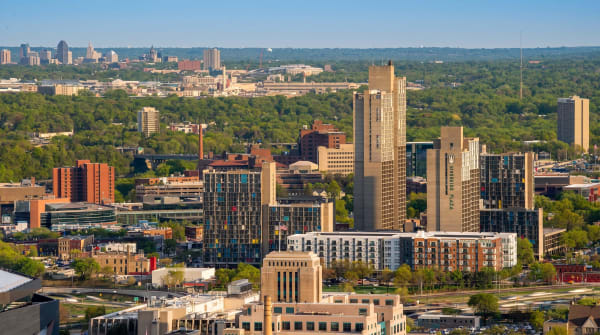
Minnesota is big water and bigger seasons, and for anyone asking whether Minnesota is a good place to retire, that geography shapes almost everything. The center of gravity is the Twin Cities metro: Minneapolis, St. Paul, and the ring of suburbs around them. This is where you'll find the deepest concentration of active adult communities, age-restricted neighborhoods, and Minnesota's distinctive senior housing cooperatives, where owners hold a share in the building rather than a deed and trade yard work for a maintenance-free lifestyle. Suburbs like Maple Grove, Woodbury, Plymouth, Lakeville, and Blaine offer walkable amenities, strong medical access, and easy proximity to grown kids and grandkids without sacrificing the quiet.
Read moreShow less
Southeast, Rochester is its own kind of magnet. The Mayo Clinic anchors the city, and a meaningful share of people who relocate to retirement communities in Minnesota do so to be near what many consider the best healthcare in the country, whether they're managing a condition or simply want that care a few minutes from home. It's a smaller, friendlier city than the metro, with a steady flow of new 55+ housing built around that healthcare draw.
Then there's the Minnesota people picture when they daydream: Duluth and the rugged North Shore of Lake Superior, and the Brainerd Lakes and central lake country stretching north from there. These are among the best places to retire in Minnesota for buyers who want a cabin-turned-primary-home rhythm: water out the back door, pontoon season, and small towns where the pace finally slows down. Active adult options here are more scattered and seasonal, but for the right person they're the whole point.
Who does Minnesota suit? People who don't flinch at winter, who value community and competence over flash, and who want genuine four-season living near excellent hospitals. The state historically loses retirees to Florida and Arizona, but in 2025 Minnesota posted its first net gain of residents from other states since 2018, and healthcare-driven relocations to Rochester and the Twin Cities are a real part of that story. If snow is a dealbreaker, it's worth knowing going in.
Explore Minnesota by region
Dive into 55+ communities by region — each guide covers local amenities, pricing, and what makes the area a fit for retirees.
Taxes for retirees in Minnesota
Minnesota is a high-tax state, with a graduated income tax running from 5.35% up to a top marginal rate of 9.85%, plus a 1% surtax on net investment income above $1 million. For retirees, the most important piece is Social Security. Minnesota still taxes Social Security benefits in principle, but the state's subtraction now gives a full exemption to most lower- and middle-income retirees. For tax year 2025, the simplified full subtraction covers married joint filers with adjusted gross income up to $108,320 and single or head-of-household filers up to $84,490, with the benefit phasing out by 10% for each $4,000 of AGI above those levels. Below those thresholds, it's a full exemption in practice.
Beyond Social Security, most other retirement income (pensions, traditional IRA and 401(k) withdrawals, annuities) is taxable at ordinary state rates, so the full picture depends on how your income is structured. Military retirement pay and qualified Roth withdrawals are not taxed, and prescription drugs, most groceries, and most clothing are exempt from sales tax. Property taxes run at a statewide effective rate of roughly 1%, and the state softens the bill with a Homestead Credit Refund tied to income, a Homestead Market Value Exclusion for owner-occupied homes, and a Senior Citizens Property Tax Deferral program that lets qualifying homeowners 65 and older defer the portion of their tax bill above 3% of household income until the home is sold.
The one thing to plan around: Minnesota has a state estate tax with an exemption of $3 million per person, well below the federal threshold, and rates running from 13% up to 16% on estates over $10.1 million. Minnesota does not allow spousal portability, so married couples generally need credit shelter trusts to fully use both exemptions. Estates above $3 million can owe Minnesota tax even when no federal estate tax is due, so anyone with significant assets should talk to an estate planner before relocating.
Minnesota climate & weather
Minnesota does four seasons without apology, and that's both the appeal and the warning. Summers are genuinely warm and often humid, long days built for the lake, the dock, the screened porch, and a state full of water to enjoy. Fall brings crisp air and hardwood color across the North Shore and lake country, and spring arrives as a relief after the long thaw.
Winter is real and it's long. Expect deep cold, meaningful snowfall, and stretches where temperatures stay below freezing for weeks. The northern half of the state and the Duluth/North Shore corridor run colder and snowier than the metro. Minnesotans manage it with good infrastructure (plowed roads, heated garages, skyway systems downtown) and a culture that leans into the season rather than hiding from it, but it asks something of you. If lake summers are worth a serious winter, Minnesota delivers. If not, that's the honest sticking point.
Cost of living in Minnesota
Minnesota lands near, and in spots slightly above, the national average on overall cost of living, which is a fair trade for what it offers. The statewide median home price sat at $370,000 in mid-2025, with the 16-county Twin Cities metro clearing $400,000 for the first time and outstate markets like Rochester, Duluth, and much of greater Minnesota still in the $250,000 to $350,000 range. Retirement homes (a townhome, a villa, or a share in a senior cooperative) typically come in at mainstream Midwest prices rather than coastal ones, with lakefront properties and the closer-in Twin Cities suburbs commanding a premium.
Read moreShow less
Property taxes are moderate but real, with a statewide effective rate around 1% and a median annual bill in the low-to-mid $3,000s. Hennepin (Minneapolis) and Ramsey (St. Paul) counties run higher; outstate and northern counties like Aitkin run notably lower. The Homestead Credit Refund and the senior property-tax deferral program are the safety valves worth knowing about.
Where Minnesota genuinely overdelivers is healthcare. The Mayo Clinic in Rochester and the University of Minnesota/M Health Fairview system put nationally ranked care within easy reach, an enormous and underrated benefit as you plan for the decades ahead. For many retirees, that quality of care alone justifies both the cost of living and the winters.
Pros of retiring in Minnesota
- World-class healthcare, with the Mayo Clinic and M Health Fairview/University of Minnesota among the best in the nation
- Social Security benefits fully exempt from state tax for most lower- and middle-income retirees (AGI up to $108,320 married, $84,490 single for 2025)
- More than 10,000 lakes plus the Lake Superior North Shore for boating, fishing, and the outdoors
- Genuine four-season living, with warm lake summers and brilliant falls
- Unusually strong inventory of senior housing cooperatives and maintenance-free 55+ communities
- A major metro in the Twin Cities with deep amenities, culture, and an international airport (MSP)
- Military pensions and qualified Roth withdrawals not taxed; groceries, prescription drugs, and most clothing exempt from sales tax
- Property tax relief through the Homestead Credit Refund, Homestead Market Value Exclusion, and a senior property-tax deferral program
- Statewide median home price around $370,000, reasonable for a high-amenity state
- Friendly, community-minded culture with strong support for older residents
- Minnesota flipped to net positive domestic migration in 2025 for the first time since 2018
Things to consider
- Long, very cold, snowy winters that aren't for everyone
- Graduated state income tax up to 9.85%, plus a 1% surtax on investment income over $1 million
- State estate tax with a $3 million exemption, well below the federal level, and rates from 13% to 16%
- No spousal portability on the estate tax; married couples generally need credit-shelter trusts to fully use both exemptions
- Most retirement income beyond Social Security (pensions, traditional IRA/401(k) withdrawals) taxable at ordinary state rates
- Far from the year-round warmth retirees find in Florida or Arizona
- Twin Cities metro median home price cleared $400,000 in 2025; desirable lakefront runs higher
- Active adult inventory thins out in rural and northern lake country
55+ communities in Minnesota: common questions
How many 55+ communities are in Minnesota?
There are 4 active adult and 55+ communities in Minnesota featured on Explore55Plus, with real photos, pricing, amenities, and resident insights for each.
How much do homes in 55+ communities in Minnesota cost?
Homes in retirement and active adult communities in Minnesota range from $350K to $750K, depending on the community, home type, and whether it's a new build or resale.
Are 55+ communities in Minnesota age-restricted?
Yes — the 55+ communities in Minnesota featured here are age-restricted, generally requiring at least one resident to be 55 or older.
Are there new-construction 55+ communities in Minnesota?
Yes — 3 of the 4 communities in Minnesota have new-construction homes available, alongside resale options in established neighborhoods.