
The Best Places to Retire in Michigan
28 cities ranked · 7 communities across 2 regions
Every Michigan retirement city, scored on 20 years of hourly weather, an itemized cost of living, and a happiness index built from federal data — then re-ranked live around your budget and ideal temperatures. When a city clicks, explore the 55+ communities inside it.
Michigan's cities, ranked for retirees
Updated August 25, 2026 · how we rank →
28 cities across Michigan · ranked for a typical buyer · 4 demoted over your $375k home budget
Found a place you like?
Create a free account to explore the 55+ communities inside these cities — photos, pricing, amenities, and a matching quiz.
Retiring in Michigan
Michigan is shaped by water more than almost any other state, and that defines where 55+ buyers land. Bordered by four of the five Great Lakes and laced with more than 11,000 inland lakes, it offers a freshwater lifestyle you can actually live on: morning walks along the shore, a pontoon at the dock, and summers locals genuinely count down to. If you're asking whether Michigan is a good place to retire, the honest answer is that it's a strong fit for a specific kind of retiree, someone who wants their money to stretch, doesn't mind a real winter, and would rather own a lake cottage than a golf-course condo in the desert.
Read moreShow less
Most 55+ buyers concentrate in a handful of regions. Metro Detroit's suburbs in Oakland and Macomb counties. Rochester, Novi, Troy, Chelsea, are the biggest cluster, with established active adult neighborhoods, top-ranked healthcare, and easy access to dining and the arts. Grand Rapids and the West Michigan lakeshore are a fast-growing second hub, pairing a friendly mid-sized city with lake towns like Holland, Grand Haven, and Saugatuck. Ann Arbor draws buyers who want a walkable college-town feel and the medical anchor of Michigan Medicine, home to one of the nation's top-ranked geriatric programs.
Farther north, the Traverse City area and the northern lakes country are the classic seasonal retirement draw. Many people start with a summer place on Grand Traverse Bay or one of the inland lakes and gradually shift to spending most of the year there, trading big-city amenities for orchards, wineries, and quiet shorelines anchored by Munson Medical Center. Petoskey and Grand Haven fill a similar niche on a smaller scale.
The best places to retire in Michigan tend to share three things: water access, a real hospital nearby, and a housing market where a mid-$300s budget still buys something meaningful. Whether you're drawn to a 55+ community near grandchildren in the Detroit suburbs or a lake home up north, the state rewards anyone who wants four genuine seasons and water never far from the front door.
Explore Michigan by region
Dive into 55+ communities by region — each guide covers local amenities, pricing, and what makes the area a fit for retirees.
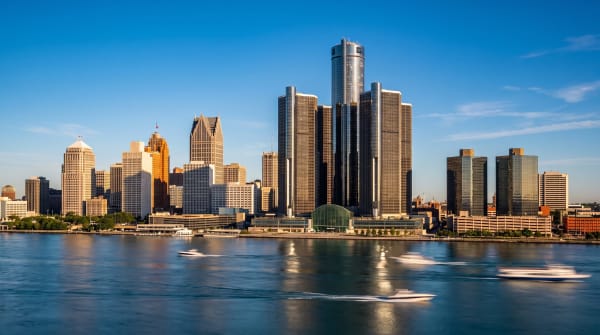
Metro Detroit / Southeast Michigan
6 communities
Great Lakes retirement value with world-class healthcare, walkable downtowns & no tax on Social Security — See why retirees are choosing Metro Detroit
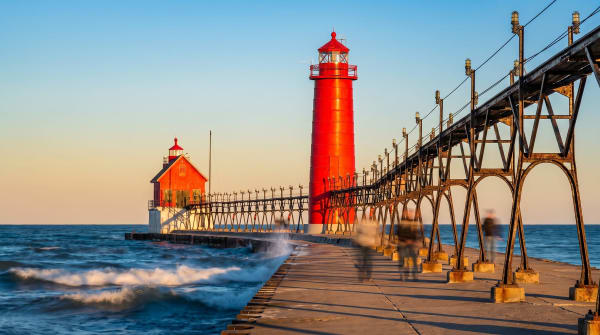
West Michigan / Grand Rapids
1 community
Michigan's second-largest metro with a Great Lakes shoreline and Beer City energy — See why retirees are choosing West Michigan / Grand Rapids
Taxes for retirees in Michigan
Michigan's tax picture for retirees has quietly become one of the friendliest in the Midwest, and 2026 is the year it fully clears up. The state runs a 4.25% flat income tax, but Social Security benefits are not taxed at all. Public Act 24 of 2025 now lets Michigan taxpayers born after 1952 and age 67 or older claim both the standard deduction and the Social Security deduction for tax years 2026 through 2028, a change that previously required picking one or the other.
The bigger news is the retirement and pension deduction. Under the 2023 Lowering MI Costs Plan (Public Act 4), Michigan spent four years phasing back the pre-2012 exemption on pension and retirement income: 25% in 2023, 50% in 2024, 75% in 2025, and 100% starting in tax year 2026. For 2026, eligible retirees can deduct up to $67,610 of qualifying retirement income on a single return and $135,220 on a joint return, indexed for inflation. That covers private pensions, traditional IRA withdrawals, and 401(k) and 403(b) distributions. Military pensions are fully exempt with no cap, and certain public safety retirees (police, fire, corrections) get an uncapped deduction on their qualifying pensions. In practice, a married couple pulling under $135,000 a year from a mix of Social Security and retirement accounts can owe Michigan effectively nothing.
Property taxes are the softer spot. The statewide effective rate averages about 1.18-1.19% of value, meaningfully above the national median of 0.89%, and the median annual bill runs roughly $3,000. Michigan softens that in two ways: Proposal A caps how fast your taxable value can rise each year while you own the home, and the Homestead Property Tax Credit gives qualifying owners and renters a credit worth up to $1,900 for 2025, with a household resources cap around $71,500. The Principal Residence Exemption also removes up to 18 mills of local school operating tax from your primary home.
Sales tax is 6% statewide with no local add-ons, which is unusual and useful. There is no estate tax and no inheritance tax in Michigan. Detroit and a handful of other cities levy their own income tax, so factor that in if you're considering an in-city address. Confirm the specifics with a tax professional before you move.
Michigan climate & weather
Michigan delivers four genuinely distinct seasons, and the Great Lakes exaggerate all of them. Summers are warm and beautiful: long days on the water, lakeshore breezes, and comfortable temperatures that make the whole state feel like vacation country. Fall brings vivid color, especially up north, and it's the season most retirees fall in love with.
Winters are the trade-off, and they're not subtle. Expect cold temperatures, snow, and frequently gray skies from November into March, with lake-effect snow piling up dramatically in the belts downwind of the lakes. Traverse City averages more than 80 inches a season, Gaylord routinely clears 130 inches, and parts of the Upper Peninsula's Keweenaw Peninsula top 200 inches, more than any location in the United States east of the Mississippi. Metro Detroit and Ann Arbor sit outside the heaviest lake-effect zones and see closer to 30-40 inches. Still real winter, but far more manageable. If cloudy days matter to you, West Michigan sees some of the least winter sunshine in the country. The long gray stretch is the price of admission for those glorious summers, and it should factor honestly into your decision.
Cost of living in Michigan
Michigan's overall cost of living sits roughly 8-10% below the national average, and housing carries the headline. The statewide median home value hovers around $270,000 in 2025-2026, well under the U.S. median near $294,000. Many active adult homes in the metro Detroit suburbs and around Grand Rapids land in the $250,000-$400,000 range, leaving room in the budget for travel, hobbies, and boating.
Read moreShow less
The clear exception is waterfront. Lakeshore towns like Holland run closer to $360,000, and Traverse City and the northern bay towns command a steeper premium, often 30-50% above the state median for anything on or near the water. That premium is real, but so is the demand: lake-adjacent homes hold value in Michigan the way beachfront does in Florida.
Healthcare in Michigan is both affordable and unusually strong for its price. Michigan Medicine at the University of Michigan in Ann Arbor is a national referral center with a top-ranked geriatric program. Beaumont/Corewell Health blankets southeast Michigan, Munson Medical Center anchors the north, and Spectrum/Corewell West covers Grand Rapids. Annual out-of-pocket healthcare costs run modestly below national norms.
One line item deserves attention before you commit: auto insurance. Michigan's no-fault system pushes average full-coverage premiums to roughly $2,750-$2,850 a year, about 25% above the national average and among the highest in the country. Groceries and utilities land near national norms, and property tax bills run $2,500-$4,000 for a typical home. If you plan to keep two cars, that insurance number can eat much of what you save on housing, so price a real quote before you decide.
Pros of retiring in Michigan
- Cost of living roughly 8-10% below the national average
- Median home value around $270,000, well below the U.S. median
- Great Lakes plus 11,000+ inland lakes for a true freshwater lifestyle
- No state tax on Social Security benefits
- Full 100% retirement and pension deduction restored in 2026 (up to $67,610 single / $135,220 joint)
- Military pensions fully exempt with no cap
- No estate tax and no inheritance tax
- 6% statewide sales tax with no local add-ons
- Lake homes and waterfront living widely available at prices that beat coastal alternatives
- Four distinct seasons with warm, beautiful summers and vivid falls
- Michigan Medicine in Ann Arbor is a nationally top-ranked geriatric center
- Strong regional hospital systems (Corewell, Munson, Trinity Health) statewide
- Proposal A caps assessment growth for long-term owners
- Homestead Property Tax Credit worth up to $1,900 for qualifying retirees
- Walkable, amenity-rich options near Detroit, Grand Rapids, Ann Arbor, and Traverse City
Things to consider
- Long, cold winters that stretch November through March
- Frequently gray, cloudy winter skies, especially in West Michigan
- Heavy lake-effect snow in the belts: 80+ inches around Traverse City, 130+ in Gaylord, 200+ in the Keweenaw
- Property tax effective rate around 1.18%, meaningfully above the national median
- Auto insurance runs about 25% above the U.S. average due to Michigan's no-fault system
- Waterfront and lakefront homes carry a real price premium
- Detroit and a few other cities levy an additional city income tax
- Fewer year-round warm-weather amenities than Sun Belt alternatives
- Lingering economic and population concerns in some legacy manufacturing areas
- Shorter outdoor recreation season for warm-weather activities
55+ communities in Michigan: common questions
How many 55+ communities are in Michigan?
There are 7 active adult and 55+ communities in Michigan featured on Explore55Plus, with real photos, pricing, amenities, and resident insights for each.
How much do homes in 55+ communities in Michigan cost?
Homes in retirement and active adult communities in Michigan range from $50K to $700K, depending on the community, home type, and whether it's a new build or resale.
Are all 55+ communities in Michigan age-restricted?
No. Of the 7 communities in Michigan, 6 are age-restricted (typically one resident 55+) and 1 is open to all ages — so you can choose either an age-restricted or an all-ages active adult community.
Are there new-construction 55+ communities in Michigan?
Yes — 3 of the 7 communities in Michigan have new-construction homes available, alongside resale options in established neighborhoods.