
The Best Places to Retire in Utah
13 cities ranked · 12 communities across 2 regions
Every Utah retirement city, scored on 20 years of hourly weather, an itemized cost of living, and a happiness index built from federal data — then re-ranked live around your budget and ideal temperatures. When a city clicks, explore the 55+ communities inside it.
Utah's cities, ranked for retirees
Updated August 25, 2026 · how we rank →
13 cities across Utah · ranked for a typical buyer · 13 demoted over your $375k home budget
Found a place you like?
Create a free account to explore the 55+ communities inside these cities — photos, pricing, amenities, and a matching quiz.
Retiring in Utah
Utah has become one of the West's more compelling retirement states, a place where a flat 4.5% income tax, some of the country's lowest effective property tax rates, and strong healthcare systems sit alongside five national parks and terrain that runs from red-rock desert to alpine ski country. Whether Utah works for retirement depends largely on which Utah you choose, because the state divides into two very different regions.
Read moreShow less
The Salt Lake City / Wasatch Front corridor is the state's economic and medical center. Intermountain Health is headquartered here, University of Utah Health's academic medical center serves the region, Salt Lake City International (a Delta hub) connects retirees to family nationwide, and world-class skiing is 30 minutes from downtown. Four-season weather is part of the deal, which means genuinely cold winters and valley inversion air-quality problems from December through February. It's the right fit for retirees who want an urban base with cultural amenities and top-tier medical access and can live with that trade-off.
St. George and Southern Utah are the opposite calculation: Mojave Desert climate, 300-plus sunny days, mild winters, and the deepest bench of 55+ active-adult communities in the state. SunRiver, Entrada at Snow Canyon, Coral Canyon, Stone Cliff, and Regency at Desert Color are among the options. The trade is 100°F-plus summer heat and a smaller healthcare network, anchored by Intermountain St. George Regional, a Level II Trauma Center.
The financial picture is fairly clean. Utah taxes Social Security and retirement income at its flat 4.5% rate, but a Social Security credit fully offsets state tax on benefits for singles under about $54,000 and couples under about $90,000, so most middle-income retirees pay little to nothing on Social Security. There's no estate or inheritance tax, and the constitutional 45% primary-residence exemption keeps property tax bills well below the national average. The overall cost of living runs a few points under the U.S. average, though home prices in both major metros have risen sharply with in-migration.
Utah won't suit everyone. It's a socially conservative state where LDS culture shapes community life, particularly in smaller southern towns. Wasatch Front air quality in winter is a genuine health concern. And the state is no longer the low-cost alternative to California it was a decade ago. For retirees who want low taxes, dramatic scenery, and the choice between snow-country and desert-sun living inside the same state, Utah makes one of the stronger cases in the West for retirement communities in utah.
Explore Utah by region
Dive into 55+ communities by region — each guide covers local amenities, pricing, and what makes the area a fit for retirees.
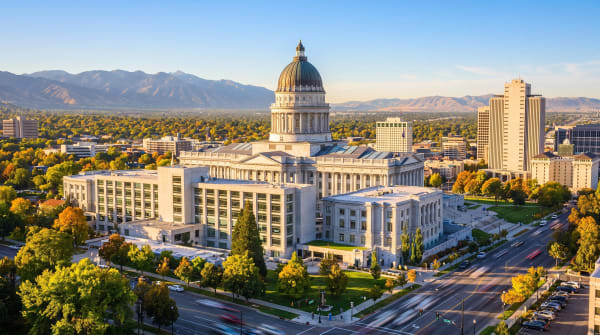
Salt Lake City / Wasatch Front
7 communities
Four-season Rocky Mountain living with world-class skiing, low property taxes & no estate tax — See why retirees are choosing Salt Lake City
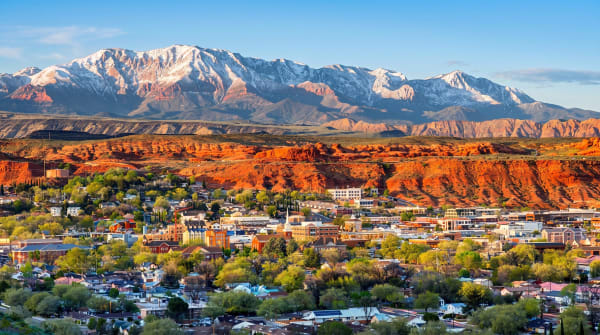
St. George / Southern UT
5 communities
Red rock desert with 300+ sunny days, Zion 40 minutes away, and Utah's deepest bench of 55+ communities — See why retirees are choosing St. George
Taxes for retirees in Utah
Utah runs a flat 4.5% state income tax as of 2025, trimmed from 4.55% in 2024 and 4.65% in 2023. That's three consecutive legislative cuts. The rate applies to all taxable income, including Social Security, pensions, and traditional IRA or 401(k) withdrawals. There's no automatic exclusion at the source; relief arrives through credits applied afterward.
The Social Security Benefits Credit fully offsets state tax on Social Security for retirees with modified adjusted gross income up to $54,000 (single) or $90,000 (joint) in 2025, thresholds raised again that session, then phases out gradually above those levels. Higher earners still owe some Utah tax on benefits. A separate Retirement Credit worth up to $450 per person is available at modest income levels, but a retiree can claim only one credit per person, not both. Military retirement pay falls under its own credit; check current rules before filing.
Property taxes are one of Utah's real advantages. The state's constitutional Primary Residential Exemption taxes a primary home on just 55% of fair market value, and effective rates land around 0.47-0.58% depending on county, well under the national 0.9-1.0% average. Utah's Circuit Breaker (Homeowner's Tax Credit) adds meaningful relief for lower-income seniors: homeowners 66 and older with household income under roughly $44,221 (2025/26) qualify for a sliding-scale credit up to $1,412, plus an additional reduction equal to tax on 20% of the home's fair market value. A CB75+ extension raises the income cap to about $85,246 for homeowners 75 and older. One catch worth noting: the age-66 threshold means Utah seniors wait a year longer than those in most neighboring states. Sales tax runs 4.85% at the state level and averages 7.26% combined with local rates; groceries are taxed statewide at a reduced 3%. Utah has no estate tax and no inheritance tax.
Utah climate & weather
Utah is a large state with two very different climates, and your zip code determines which one you actually live in. The Wasatch Front (Salt Lake City, Ogden, Provo) sits around 4,300 feet and gets four distinct seasons: hot dry summers that regularly reach the mid-90s and occasionally top 100°F, snowy winters with lake-effect powder off the Great Salt Lake, and comfortable spring and fall shoulders. Low year-round humidity makes both the heat and the cold more manageable than the numbers suggest. The significant catch is winter inversions. From December through February, a warm layer traps cold, polluted air in the valley. Salt Lake City ranked 9th-worst in the U.S. for ozone and 19th-worst for short-term particle pollution in 2024. Wildfire smoke adds a second bad-air stretch in mid-to-late summer. Both are real concerns for retirees managing heart, lung, or asthma conditions.
Southern Utah is a different place entirely. St. George sits at 2,800 feet in the Mojave Desert with roughly 255-300 sunny days a year, about 8 inches of annual precipitation, and winter highs in the mid-50s where snow typically melts before noon. July and August are the trade: triple-digit temperatures are routine, and most retirees structure those months around early mornings, pools, and short drives up to cooler elevations at Pine Valley or nearby national parks. That same climate has made St. George one of the fastest-growing retirement destinations in the West.
Cost of living in Utah
Utah's overall cost of living runs about 95-98% of the U.S. average, below high-cost peers like California (index near 140) but no longer a bargain state. Housing is the biggest variable. The Salt Lake City median home price sits around $580,000 as of 2026, with inventory tight enough that homes move in under a month. The broader Wasatch Front (Ogden, Provo, Lehi) offers somewhat lower price points but the same constrained supply. St. George is its own market: the 55+ segment runs from park-model and manufactured-home communities under $200,000 up through mid-range townhomes and villas in the $300,000-$500,000 range, to luxury builds well past $1 million in communities like Entrada at Snow Canyon or Stone Cliff.
Read moreShow less
Day-to-day costs help offset the housing bill. Utilities in a typical single-family home run roughly $250-$400 a month; electric bills average around $74. Groceries carry a reduced statewide tax of 3%. Gas and auto insurance both sit below national averages. The flat 4.5% income tax is well below what retirees pay in California, New York, or Oregon, and the 45% primary-residence exemption keeps annual property tax bills modest at roughly $470-$550 per $100,000 of home value.
For retirees specifically: Medicare Advantage penetration is high in Utah, and both Intermountain SelectHealth and University of Utah Health plans carry strong statewide provider networks. Average assisted living runs about $3,400 a month, notably below the national $4,300. HOA fees in the popular St. George 55+ communities cluster in the $75-$310 per month range depending on amenities (SunRiver, Santa Fe at Red Cliffs, Meadow Creek, Ridgepointe). Read what's included, since some cover cable, water, and exterior maintenance while others don't. Two honest caveats: home prices in both metros have climbed sharply with in-migration, and Wasatch resort day-lift tickets now run $190-$280 if skiing is part of the appeal.
Pros of retiring in Utah
- Flat 4.5% state income tax (down from 4.85% in 2022) with three straight years of legislative rate cuts
- Social Security Benefits Credit fully offsets state tax on benefits for singles under ~$54K / couples under ~$90K (2025)
- No estate tax and no inheritance tax
- 45% primary residence property tax exemption with effective rates of 0.47-0.58%, among the lowest in the country
- Circuit Breaker credit up to $1,412 for lower-income homeowners 66+, with a CB75+ extension raising income limits for those 75 and older
- Intermountain Health (33 hospitals) headquartered in Salt Lake City and University of Utah Health, a top-ranked academic medical center
- Intermountain St. George Regional is a Level II Trauma Center, unusually strong healthcare for a metro that size
- Five national parks (Zion, Bryce, Arches, Canyonlands, Capitol Reef) plus world-class skiing 30 minutes from downtown SLC
- St. George offers 300-plus sunny days, mild winters, and one of the deepest lineups of retirement communities in Utah (SunRiver, Entrada, Coral Canyon, Stone Cliff)
- Salt Lake City International (SLC) is a Delta hub with nonstops nationwide, a genuine advantage for retirees with family spread across the country
- Dry-heat climate makes summer temperatures more tolerable than humid Sun Belt alternatives
- Low crime rates and Utah consistently ranks among the most volunteer-oriented, community-minded states
- Cost of living index around 96, below the national average and dramatically below California
Things to consider
- Utah taxes Social Security, pensions, and IRA/401(k) withdrawals at the flat 4.5% rate. Credits help but don't eliminate the bill for higher-income retirees
- Circuit Breaker property tax relief starts at age 66, not 65 as in most states, meaning one extra year of waiting
- Home prices along the Wasatch Front have climbed sharply; the Salt Lake City median sits around $580,000 and rising
- Winter inversions trap pollution in the Salt Lake Valley; SLC ranked 9th-worst U.S. city for ozone in 2024, a real concern for anyone with respiratory conditions
- Wildfire smoke has become a recurring summer air-quality problem across the state
- St. George summers regularly break 100°F from mid-June through mid-September
- LDS (Mormon) culture is a dominant social feature; Utah is roughly 42-60% LDS statewide and higher in southern towns, and non-members sometimes find it harder to build deep social connections
- Strict liquor laws and state-run package stores can catch transplants off guard
- Rapid population growth has brought I-15 traffic congestion and rising pressure across housing markets
- Limited direct healthcare access in Utah's rural southeast and eastern regions
55+ communities in Utah: common questions
How many 55+ communities are in Utah?
There are 12 active adult and 55+ communities in Utah featured on Explore55Plus, with real photos, pricing, amenities, and resident insights for each.
How much do homes in 55+ communities in Utah cost?
Homes in retirement and active adult communities in Utah range from $250K to $1M, depending on the community, home type, and whether it's a new build or resale.
Are all 55+ communities in Utah age-restricted?
No. Of the 12 communities in Utah, 10 are age-restricted (typically one resident 55+) and 2 are open to all ages — so you can choose either an age-restricted or an all-ages active adult community.
Are there new-construction 55+ communities in Utah?
Yes — 10 of the 12 communities in Utah have new-construction homes available, alongside resale options in established neighborhoods.