
The Best Places to Retire in Rhode Island
4 cities ranked · 2 communities across 1 region
Every Rhode Island retirement city, scored on 20 years of hourly weather, an itemized cost of living, and a happiness index built from federal data — then re-ranked live around your budget and ideal temperatures. When a city clicks, explore the 55+ communities inside it.
Rhode Island's cities, ranked for retirees
Updated August 25, 2026 · how we rank →
4 cities across Rhode Island · ranked for a typical buyer · 4 demoted over your $375k home budget
Found a place you like?
Create a free account to explore the 55+ communities inside these cities — photos, pricing, amenities, and a matching quiz.
Retiring in Rhode Island
Rhode Island is the smallest state in the country, and that turns out to be one of its quiet advantages for retirement. You are never more than a short drive from the water, from Providence, or from a town green where everyone seems to know the pharmacist by name. More than 19 percent of Rhode Islanders are already 65 or older, so retirees are a meaningful part of the state's rhythm, not an afterthought. For people asking whether Rhode Island is a good place to retire, the Ocean State packs an unusual amount of coastline, history, and walkable New England character into a footprint you can cross in under an hour.
Read moreShow less
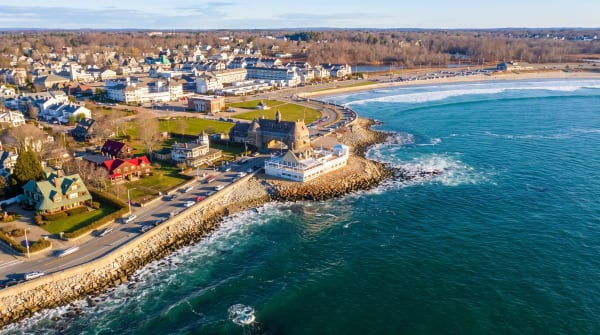
Most 55+ buyers concentrate in a few distinct pockets, and all of them fall under the site's single Rhode Island area page. The coastal South County towns of Narragansett, South Kingstown, and Westerly draw those who want beaches, salt ponds, and a slower seaside pace, with the University of Rhode Island adding lectures and cultural life. Newport and the rest of Aquidneck Island (Middletown, Portsmouth, and Jamestown just across the bridge) are the showpiece of the state, known for Gilded Age mansions, sailing, and a restaurant scene that punches far above its size. Buyers pay for the privilege.
The Providence metro suburbs are where you'll find the most practical everyday options. Warwick, Cranston, and East Greenwich give easy access to T.F. Green Airport, the Brown University Health hospital network, and the city's dining and arts scene. East Greenwich in particular has a polished Main Street and consistently ranks near the top of best-places-to-retire lists for the state. Farther east, Bristol and Barrington are walkable, historic downtowns on the bay. Out in the quieter western half, toward Coventry and West Greenwich, you trade some convenience for more land, lower density, and a more rural feel.
What ties it together is a small-state, coastal New England lifestyle: four real seasons, the Atlantic always close, and short distances between everything. It suits people who want culture, water, and history without the sprawl of a big state, and who like being a manageable drive from Boston for Red Sox games and Mass General-caliber specialty medicine when they need it.
Explore Rhode Island by region
Dive into 55+ communities by region — each guide covers local amenities, pricing, and what makes the area a fit for retirees.
Taxes for retirees in Rhode Island
Rhode Island is a mixed bag for retirees, and the details matter before you fall in love with a coastline view. The state has a graduated income tax with rates from 3.75 percent up to 5.99 percent across three brackets. Social Security benefits are exempt for residents who have reached full retirement age and stay under the AGI limits, and a significant change took effect in 2025: the Pension and Annuity Income Modification lets qualifying retirees subtract up to $50,000 of taxable pension, 401(k), 403(b), or annuity income, up from just $20,000 the year before. For 2025 the AGI ceilings are roughly $107,000 (single) and $133,750 (married filing jointly), and both breaks are all-or-nothing. Cross the line by a dollar and you lose the full exemption. Military retirement pay is treated even better: 100 percent exempt at the state level with no age or income limits, and the exemption continues for surviving spouses.
The biggest gotcha is that IRAs are not eligible for the pension modification. Traditional IRA distributions remain fully taxable at the state level even if you meet every other test, which matters a lot for retirees whose main nest egg is an IRA rather than an employer plan. If you're rolling a 401(k) into an IRA at retirement, the timing of that move has real Rhode Island tax consequences worth running past a planner.
Property taxes are on the higher side and vary dramatically by town. Residential rates range from about $4.79 per $1,000 of assessed value in Little Compton to over $21 per $1,000 in Foster, with a statewide average around $12.13 and an effective rate near 1.05 percent. There is no statewide homestead exemption; each of the 39 cities and towns sets its own rules. Roughly half of municipalities offer a homestead reduction, typically $15,000 to $30,000 off assessed value, and most have a senior exemption at 65 with an income test. A state-level Circuit Breaker credit worth up to $600 is also available for lower-income senior homeowners. Two homes of similar value can carry very different annual bills depending on the municipality, so it pays to run the numbers town by town.
The item most people overlook: Rhode Island has its own estate tax with one of the lowest thresholds in the country, sitting at $1,838,056 for 2026 (up from $1,802,431 in 2025 and indexed annually to CPI-U). Estates above that line face graduated rates up to 16 percent, and unlike the federal system, Rhode Island's exemption is not portable between spouses. For buyers with an appreciated home, a retirement account, and a life insurance policy, that threshold is easier to hit than most people expect. Coastal Rhode Island real estate alone can eat most of it, so estate planning belongs on the pre-move checklist.
Rhode Island climate & weather
Rhode Island has four genuine seasons, and the ocean shapes all of them. Statewide annual temperatures average 49 to 52°F, but where you live in this small state changes winter more than you'd expect. Summers are warm and humid. Providence averages around 74°F in July, but sea breezes ease the heat along the coast, and beach days stretch from June into September. Spring and fall are the gentlest stretches, with crisp air, classic New England foliage, and comfortable temperatures for walking historic downtowns like Wickford, Bristol, and Newport.
Winters are cold and snowy, the reality of living this far north on the Atlantic. January averages hover near 29°F in Providence and dip lower inland. The snow story splits the state: Providence County and western Kent County typically see 40 to 60 inches a year, while Washington County, the Narragansett Bay shoreline, and Block Island get only 20 to 40 inches. Coastal towns also see far fewer nights below zero than inland communities. The trade-off is exposure to nor'easters and coastal storms. Sea level at Newport has risen more than 9 inches since 1930, faster than the global average, and coastal flooding during winter storms is a growing consideration for waterfront buyers.
Cost of living in Rhode Island
Rhode Island runs above the national average for cost of living, and housing does most of the lifting. The statewide median home price sits in the low $500,000s (Zillow put it at $506,723 in mid-2025, Redfin higher), well above the U.S. median and roughly on par with New Hampshire and Oregon. Providence's median has climbed to around $580,000, and East Greenwich, Barrington, Jamestown, and the prime Newport and coastal South County addresses go well above that. In Little Compton, one estimate pegged the income needed to comfortably afford a median-priced home at $174,000.
Read moreShow less
In the 55+ market specifically, more attainable pricing tends to show up in the Providence-area suburbs like Warwick, Cranston, and East Providence, while Newport, East Greenwich, and the prime coastal towns push toward the high end. Purpose-built active adult inventory is limited compared to the Carolinas or Florida. The most established options include Bailey Brook, South Shore Village, Bella Vista, Bay Ridge, and The Villages on Mount Hope Bay, and when a home hits the market it moves quickly.
Retiree-specific costs: property taxes are the big variable (a $500,000 home in Foster carries a very different bill than the same home in Little Compton), utilities and home heating oil run high through winter, and homeowners insurance on coastal or bay-facing property has climbed sharply as carriers reprice hurricane and flood risk. Groceries and healthcare land near or slightly above the national average. Gas has recently averaged around $3.03 a gallon.
Healthcare access is a genuine strength. Brown University Health (the rebranded Lifespan system as of late 2024) anchors the state with Rhode Island Hospital, The Miriam, and Newport Hospital, all affiliated with Brown's Warren Alpert Medical School. Care New England runs Kent Hospital in Warwick and Women & Infants. South County Hospital in Wakefield holds a 5-star CMS overall quality rating and is nationally recognized for patient experience. When something truly complex comes up, Boston's Mass General, Brigham, and Dana-Farber are all inside an hour's drive from most of the state. That combination of capable local care plus a world-class backstop up I-95 is a real part of Rhode Island's retirement value.
Pros of retiring in Rhode Island
- Coastline is always close, with 400 miles of shoreline, beaches, salt ponds, and harbor towns across the state
- Newport's Gilded Age mansions, sailing culture, and dining give the area rare charm
- Walkable, historic downtowns like East Greenwich, Wickford, and Bristol
- Close to Boston for sports, culture, and Mass General-caliber specialty medicine
- Social Security exemption plus a $50,000 pension/401(k) modification for qualifying retirees at full retirement age (raised from $20,000 in 2025)
- Military retirement pay is 100 percent exempt with no age or income limits
- Four real seasons with classic New England spring and fall
- Small-state convenience means most drives are under an hour
- Strong local healthcare anchored by Brown University Health (formerly Lifespan) and top-rated South County Hospital
- University of Rhode Island and Brown add lectures and cultural life
- Providence has big-city arts, dining, and T.F. Green Airport without big-city sprawl
- Coastal towns get noticeably less snow than inland Rhode Island (20 to 40 inches vs. 40 to 60 inches annually)
- Waterfront living at a smaller, more navigable scale than larger coastal states
Things to consider
- Property taxes are relatively high and vary sharply by town, from about $4.79 to over $21 per $1,000 of assessed value
- Rhode Island has its own estate tax with one of the lowest thresholds in the country ($1,838,056 for 2026) and no spousal portability
- IRA distributions are not eligible for the state's pension exemption, unlike 401(k) and pension income
- Cold winters with 40 to 60 inches of snow inland and stretches of raw coastal weather
- Overall cost of living runs above the national average and housing is well above it
- Median home price in the low $500,000s statewide; Newport and South County carry a steep premium
- Limited inventory of purpose-built 55+ active adult communities compared to Sunbelt states
- Graduated income tax up to 5.99 percent, with retirement exemptions phased out above income limits
- Coastal flooding and hurricane exposure are rising, and waterfront insurance costs reflect it
- Summer tourism crowds Newport and the popular South County beach towns
- The smallest state offers less geographic variety than larger retirement destinations
55+ communities in Rhode Island: common questions
How many 55+ communities are in Rhode Island?
There are 2 active adult and 55+ communities in Rhode Island featured on Explore55Plus, with real photos, pricing, amenities, and resident insights for each.
How much do homes in 55+ communities in Rhode Island cost?
Homes in retirement and active adult communities in Rhode Island range from $700K to $1M, depending on the community, home type, and whether it's a new build or resale.
Are 55+ communities in Rhode Island age-restricted?
Yes — the 55+ communities in Rhode Island featured here are age-restricted, generally requiring at least one resident to be 55 or older.
Are there new-construction 55+ communities in Rhode Island?
Yes — 2 of the 2 communities in Rhode Island have new-construction homes available, alongside resale options in established neighborhoods.