
The Best Places to Retire in North Carolina
24 cities ranked · 75 communities across 5 regions
Every North Carolina retirement city, scored on 20 years of hourly weather, an itemized cost of living, and a happiness index built from federal data — then re-ranked live around your budget and ideal temperatures. When a city clicks, explore the 55+ communities inside it.
North Carolina's cities, ranked for retirees
Updated August 25, 2026 · how we rank →
24 cities across North Carolina · ranked for a typical buyer · 10 demoted over your $375k home budget
Found a place you like?
Create a free account to explore the 55+ communities inside these cities — photos, pricing, amenities, and a matching quiz.
Retiring in North Carolina
North Carolina has become one of the country's most popular retirement destinations for people 55 and older, and the reasons are concrete rather than scenic. There is no state tax on Social Security. The flat income tax has dropped to 3.99% for 2026 and is scheduled to keep falling. Property taxes run well below the national average. And the geography stretches from the Blue Ridge and Great Smoky Mountains in the west, across the rolling Piedmont, down to a long Atlantic coastline, which means you can match the setting to your life rather than accepting whatever a single climate offers. That variety is why the best places to retire in North Carolina really do sit in different worlds.
Read moreShow less
Most 55+ buyers concentrate in five regions. The Charlotte area is the biggest draw, a banking and business hub with active adult communities spreading into Lake Norman, Concord, Mooresville, and the border towns just south of the city. The Raleigh / Durham / Triangle appeals to retirees who want top-tier hospitals, universities, and steady cultural life, and it has some of the deepest 55+ inventory in the state. Asheville and western North Carolina pull buyers who want cooler summers, four real seasons, and an arts-and-outdoors culture. Along the coast, Wilmington and Brunswick County (including fast-growing Leland, Calabash, and the Southport area) offer beach access and golf-heavy planned communities. The Greensboro / Winston-Salem / Triad sits in the middle: lower cost of living, solid healthcare, and easy reach in every direction. And Pinehurst and Southern Pines, tucked between the Triangle and Charlotte, remain the state's golf capital.
The four-season-but-mild climate is a significant part of the appeal. Spring and fall are long and comfortable. Summers are warm. Winters are short and rarely harsh, without Florida's relentless heat or the Northeast's snow load. That climate is part of why golf and outdoor life are central to so many North Carolina retirement communities, from Del Webb developments to smaller regional builders.
Is North Carolina a good place to retire? For most people asking, yes, particularly buyers coming from higher-cost states who want their housing dollar to stretch, golfers and outdoor lovers, and anyone who likes the idea of mountains, city, and coast within a half-day's drive. Retiring in North Carolina is not one decision but five very different ones, so the practical advice is to pick the region before you pick the community.
Explore North Carolina by region
Dive into 55+ communities by region — each guide covers local amenities, pricing, and what makes the area a fit for retirees.

Asheville / Western NC
8 communities
Blue Ridge Mountain retirement with four true seasons and a top-rated arts, food & healthcare scene — See why retirees are choosing Asheville & Western NC

Charlotte Area
14 communities
Banking capital of the South with Lake Norman, Blue Ridge foothills & a mild four-season climate — See why retirees are choosing the Charlotte area

Greensboro / Winston-Salem / Triad
4 communities
Two mid-size Piedmont cities, four real seasons & no-Social-Security-tax retirement — See why retirees are choosing the NC Triad
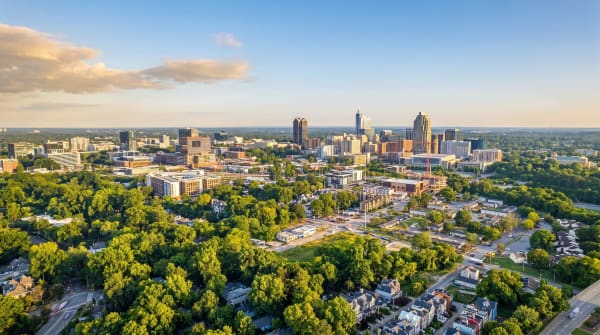
Raleigh / Durham / Triangle
28 communities
Three-university research hub with no tax on Social Security & four true seasons — See why retirees are choosing the Raleigh-Durham Triangle

Wilmington / Coastal NC
21 communities
Historic port city, Carolina beaches & no tax on Social Security — See why retirees are choosing Wilmington and Coastal NC
Taxes for retirees in North Carolina
North Carolina is reasonably friendly to retirees, though not the most generous state in the Southeast. It uses a single flat income tax rate that has been declining by law: 4.25% for 2025 and 3.99% for 2026, with further cuts to 3.49% possible in 2027 if revenue targets are met. Social Security benefits are not taxed at all, which is the headline break for most retirees.
Other retirement income gets less favorable treatment. Pensions, 401(k) withdrawals, and traditional IRA distributions are taxed at the flat rate like ordinary income, and there is no general age-based retirement income exclusion of the kind South Carolina offers. Two exceptions matter. The Bailey exemption fully shields qualifying federal, state, and local government pensions for retirees who had at least five years of creditable service by August 12, 1989, tracing to a 1998 court settlement. Under a separate 2022 law, military retirement pay is fully deductible for veterans with 20 or more years of service or a medical retirement. If neither applies, your 401(k) and IRA withdrawals are taxed at 3.99% in 2026, comparable to what many higher-income retirees face in neighboring states, and lower than South Carolina's top bracket.
On the property side, North Carolina's effective property tax rate runs about 0.63-0.73% of home value (Tax Foundation and SmartAsset methodologies differ), well below the national average of roughly 0.90%. The Homestead Exclusion shelters the greater of $25,000 or 50% of a primary residence's value for homeowners 65 or older (or permanently disabled) with income below the annual threshold. Combined state-and-local sales tax averages about 7%. There is no state estate tax and no inheritance tax, a genuine plus for estate planning.
North Carolina climate & weather
North Carolina has four distinct but mild seasons, which matters to retirees who want change without extremes. Summers are warm and humid, especially in the Piedmont and along the coast. Spring and fall are long and comfortable, often the best time of year to be outdoors. Winters are short and generally easy, with cold snaps rather than sustained deep freezes across most of the state.
The climate shifts noticeably by region. The mountains around Asheville run cooler year-round, see the most genuine winter weather including occasional snow, and offer real relief from summer heat. The central Piedmont (Charlotte, the Triangle, the Triad) is warmer and more humid in summer but still mild in winter. The coast around Wilmington and Brunswick County is the warmest and most humid, with ocean breezes but also real exposure to Atlantic hurricanes and tropical storms, an exposure that is now showing up plainly in homeowners insurance premiums.
Cost of living in North Carolina
North Carolina's overall cost of living runs a few points below the national average, roughly index 94 versus 100 nationally, which is a meaningful part of its draw for retirees. Housing is the biggest factor. The statewide median home price sits around $360,000-$378,000 as of 2026 depending on the source, with Zillow's average home value near $332,000, placing North Carolina 26th among states. That's cheaper than Florida or Virginia but noticeably more than South Carolina or Tennessee. In practical terms, prices are lower in smaller inland and golf-country communities, mid-range across most suburban active adult developments in the Triangle and Charlotte suburbs, and a real premium in Asheville, the Wilmington and Brunswick coast, and the Pinehurst village.
Read moreShow less
Property taxes stay manageable statewide. An effective rate of 0.63-0.73% keeps most bills well under what buyers from the Northeast or Midwest are used to, though county rates vary from about 0.50% to just under 1.00%, and Durham, Guilford, and Forsyth counties run higher than the state average. Sales tax averages around 7% combined, with groceries taxed at a reduced 2% local rate.
Homeowners insurance is the line item to watch. After a contested 2025 settlement, statewide rates rose 7.5% in June 2025 and another 7.5% in June 2026, a cumulative 15%, with New Hanover, Brunswick, and Pender coastal counties hit far harder at roughly 31.9% over those two years. Average annual premiums are running about $2,900-$3,100 statewide; comprehensive coverage with separate wind and hail riders in beach areas can push $6,000 or more, on top of any HOA and CDD-style dues in planned 55+ communities.
Healthcare is a genuine strength worth weighing alongside cost. North Carolina is home to nationally regarded systems including Duke Health and UNC Health in the Triangle and Atrium Health in the Charlotte region, plus solid regional hospitals in Asheville, Winston-Salem, and Wilmington. For most retirees, the practical answer to how much money you need to retire comfortably in North Carolina lands around $53,000 a year for a single retiree and $75,000 for a couple, per recent Investopedia analysis, figures that translate to a nest egg near $740,000 for a single or $940,000 for a couple after Social Security is factored in.
Pros of retiring in North Carolina
- No state tax on Social Security benefits
- Flat state income tax already at 3.99% for 2026 and scheduled to keep declining
- No state estate tax and no inheritance tax
- Effective property tax rate well below the national average
- Military retirement pay fully deductible for 20-year or medically retired veterans
- Bailey exemption fully shelters qualifying government pensions for those vested by August 12, 1989
- Four mild, genuinely distinct seasons without harsh winters or relentless heat
- Mountains, Piedmont, and coast within a half-day's drive of each other
- Strong golf and active-outdoor culture, anchored by Pinehurst and Southern Pines
- Nationally regarded healthcare through Duke, UNC, and Atrium systems
- Overall cost of living several points below the national average
- Housing dollars stretch further than in many higher-cost Northern and coastal states
- Growing inventory of 55+ and active adult communities across all five major regions
- Major airports in Charlotte (CLT) and Raleigh-Durham (RDU) for travel and family visits
- Seniors 65+ can audit UNC-system and community college classes tuition-free
Things to consider
- Pensions, 401(k), and traditional IRA withdrawals are taxed at the flat state rate
- No general age-based retirement income exclusion (unlike South Carolina's $10,000-$15,000 deductions)
- Bailey exemption only helps government retirees vested by August 12, 1989
- Homeowners insurance rates rose 15% statewide over 2025-2026, with coastal counties up nearly 32%
- Coastal counties (Brunswick, New Hanover, Pender, Carteret) carry real hurricane and tropical-storm risk
- Summers are warm and humid, especially in the Piedmont and along the coast
- Home prices in Charlotte, the Triangle, Asheville, and the coast have climbed well past pre-2020 levels
- Fast population growth brings traffic and congestion in Charlotte and the Triangle
- Mountain areas can see winter weather and occasional snow that complicates travel
- South Carolina generally wins on property tax and retirement-income deductions for many retirees
55+ communities in North Carolina: common questions
How many 55+ communities are in North Carolina?
There are 75 active adult and 55+ communities in North Carolina featured on Explore55Plus, with real photos, pricing, amenities, and resident insights for each.
How much do homes in 55+ communities in North Carolina cost?
Homes in retirement and active adult communities in North Carolina range from $200K to $1M, depending on the community, home type, and whether it's a new build or resale.
Are all 55+ communities in North Carolina age-restricted?
No. Of the 75 communities in North Carolina, 44 are age-restricted (typically one resident 55+) and 31 are open to all ages — so you can choose either an age-restricted or an all-ages active adult community.
Are there new-construction 55+ communities in North Carolina?
Yes — 52 of the 75 communities in North Carolina have new-construction homes available, alongside resale options in established neighborhoods.