
The Best Places to Retire in New Hampshire
2 cities ranked
Every New Hampshire retirement city, scored on 20 years of hourly weather, an itemized cost of living, and a happiness index built from federal data — then re-ranked live around your budget and ideal temperatures. When a city clicks, explore the 55+ communities inside it.
New Hampshire's cities, ranked for retirees
Updated September 25, 2026 · how we rank →
2 cities across New Hampshire · ranked for a typical buyer · 2 demoted over your $375k home budget
Found a place you like?
Create a free account to keep this list ranked your way and explore the 55+ communities inside these cities — photos, pricing, amenities, and local agents.
Retiring in New Hampshire
New Hampshire made an unlikely leap onto every retirement shortlist in 2025 when Bankrate named it the #1 state to retire, ahead of Florida, Arizona, and the Carolinas. The Granite State finished first in neighborhood safety and scored in the top ten for healthcare, taxes, and share of similar-aged residents, enough to overcome a 40th-place weather ranking that nobody is trying to hide. For retirees asking whether New Hampshire is a good place to retire, the honest answer is: yes, if you can handle winter.
Read moreShow less
The money story is straightforward. There is no state income tax on wages, Social Security, pensions, 401(k) or IRA withdrawals, and as of January 1, 2025, no tax on interest and dividends either. There is no sales tax and no estate or inheritance tax. What New Hampshire does have is property tax, and plenty of it: effective rates around 1.5-1.6% land the state in the top five nationally. Every retiree's calculus here comes down to how much of that trade they can absorb. Towns administer an Elderly Exemption that reduces assessed value meaningfully for homeowners 65+ with three years of NH residency.
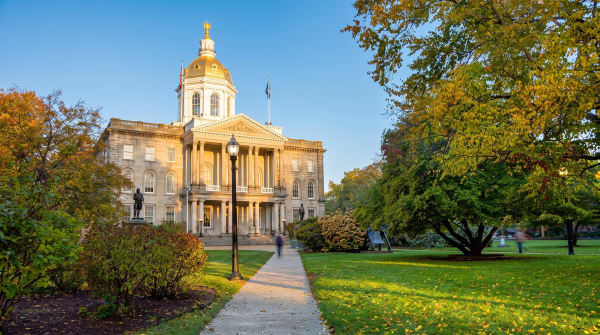
The climate trade-off is the other honest bar. Summers are warm and short, fall is the reason New England exists, and winters are genuine: snow, ice, and cold that require preparation and, for many, a February trip somewhere warmer. In exchange you get some of the country's best small-city living: Portsmouth's historic Seacoast, the walkable state capital of Concord, Hanover's Dartmouth-fueled intellectual scene, and the lakes-and-mountains lifestyle of the Lakes Region around Lake Winnipesaukee (Gilford, Meredith, Laconia). Healthcare access is a genuine strength. Dartmouth Hitchcock Medical Center in Lebanon is the state's only academic medical center and Level 1 trauma center, and northern New England's only NCI-designated Comprehensive Cancer Center. Catholic Medical Center, Elliot Hospital, Concord Hospital, and Portsmouth Regional round out a strong network.
This state suits retirees who value safety, four seasons, and tax-friendly treatment of retirement income; who are comfortable driving; and who would rather pay high property taxes than income taxes. Retirees weighing New Hampshire against Maine will find NH the stronger financial choice, as Maine taxes most retirement income where New Hampshire does not. Explore the New Hampshire regions and <a href="/55-plus-communities/new-hampshire">55+ communities</a> to find the setting (Seacoast, Lakes Region, Upper Valley, or capital area) that fits.
Explore New Hampshire by region
Dive into 55+ communities by region — each guide covers local amenities, pricing, and what makes the area a fit for retirees.
Taxes for retirees in New Hampshire
New Hampshire is one of the most tax-friendly states in the country for retirement income, and as of 2025, that statement no longer needs an asterisk. The state taxes none of the following: wages, Social Security, pensions (private, public, federal, or military), 401(k) withdrawals, IRA distributions, or annuities. On January 1, 2025, New Hampshire's last remaining income-type tax, the Interest and Dividends Tax, was fully repealed, so investment income is now untaxed at the state level too. There is also no general sales tax and no estate or inheritance tax. A retiree pulling $40,000 from a pension, $25,000 from Social Security, and $10,000 in dividends owes the State of New Hampshire zero.
The catch is property tax. New Hampshire funds schools, roads, and municipal services almost entirely through local property levies, and its effective property tax rate (roughly 1.5% to 1.6% of assessed value, depending on the source and the town) ranks among the top five in the nation. On a $525,000 home at a 1.5% effective rate, that's around $7,800 a year, and it varies sharply town by town: two houses of identical value ten miles apart can have wildly different bills. Before buying, check the current tax rate per $1,000 of assessed value in the specific town you're considering.
There is meaningful relief for seniors. Every municipality administers the state Elderly Exemption (RSA 72:39-a) for homeowners age 65+ who have lived in New Hampshire at least three consecutive years, with income and asset limits set locally. The exemption reduces assessed value, not the tax bill directly, and scales up with age. In Salem, the reduction is $156,000 for ages 65-74, $234,000 for 75-79, and $318,500 for 80+; Concord and Durham publish similar tiered brackets. There is also an Elderly and Disabled Tax Deferral program that lets qualifying seniors defer property taxes until the home is sold. Not every retiree will qualify, but for those on fixed incomes the exemption can knock four figures off the annual bill. Two other taxes to know: New Hampshire charges an 8.5% Meals and Rentals Tax on prepared food and short-term lodging, and a Real Estate Transfer Tax applies when you buy.
New Hampshire climate & weather
New Hampshire has a humid continental climate with four genuinely distinct seasons, the trade-off nearly every retiree here weighs against the tax picture. Summers are warm, humid, and short: daytime highs from June through August typically run in the low 80s along the coast and in Manchester, cooler in the mountains, with rain spread evenly across the year. Fall is the state's signature season and the reason leaf-peepers flood the Kancamagus Highway and the Monadnock Region every October. Winters are the real conversation. January highs hover near 32°F on the coast and can sit near 0°F in the northern interior, snowfall averages 30-50 inches across most of the state and considerably more at higher elevations, and nor'easters occasionally drop multiple feet at once or coat the region in ice storms that take down trees and power lines.
Region matters. The Seacoast (Portsmouth, Exeter, Dover) is the warmest corner of the state, moderated by the Atlantic. Southern-tier cities like Nashua and Manchester behave much like eastern Massachusetts. The Lakes Region and Upper Valley get colder, snowier winters. The North Country and White Mountains get subarctic winter conditions, and Mount Washington famously records some of the most extreme wind and cold in the Lower 48. Winters have gradually warmed and snowfall has trended down since the 1970s, but genuine winter (driveway plowing, snow tires, and shoveling) is still the baseline. Retirees who leave for January and February (snowbirding to Florida or the Carolinas) are common enough that many communities are built around the pattern.
Cost of living in New Hampshire
New Hampshire is not a cheap state. The overall cost of living runs roughly 10-15% above the national average, driven overwhelmingly by housing. BEA's Regional Price Parity puts services at 33% above the U.S. average and rents about 15% above; other indexes place the composite closer to 112-113. What softens the blow for retirees is what New Hampshire doesn't charge: no state income tax, no sales tax, no tax on Social Security or retirement withdrawals. That changes the math considerably versus neighboring Massachusetts, Vermont, and Maine.
Read moreShow less
Housing is the headline number. The statewide median single-family sale price hit a record $580,000 in July 2026, per the New Hampshire Association of Realtors, and Zillow's statewide home value index sits around $523,000. Regional spread is significant: Belknap County (Lake Winnipesaukee towns like Meredith, Laconia, Alton, Gilford) recently posted a $615,000 median; Coos County in the far north sits around $269,000; Manchester's Zillow value is roughly $442,000. Inventory is tight, around 2.6 months of supply, and homes sell close to list price. Property taxes, as covered in the tax section, rank among the highest in the country and vary town to town; budget 1.4-2.0% of home value annually.
Other categories: groceries run about 10% above the national average, utilities and healthcare a few points above, and gas prices near or slightly below the U.S. average. Per-person healthcare spending averages roughly $9,900 annually according to BEA data, high in absolute dollars, but access is a genuine bright spot.
For retirees specifically: a paid-off $300,000 home might carry $6,000-$7,000 a year in property tax, with no income or sales tax on any Social Security, pension, or IRA withdrawal, a very different profile from a Massachusetts or New York retiree. Seniors age 65+ with three years of NH residency can apply for the local Elderly Exemption, which reduces assessed value and can trim thousands off the bill in higher-value towns. There is no property tax freeze, and reassessments do happen.
A few honest caveats: public transit outside Manchester, Concord, and a few walkable downtowns is limited to nonexistent, so a car is essentially required. Home heating costs (oil and propane are common) are real winter expenses. Home insurance is straightforward compared to hurricane and wildfire states, but ice-dam damage and long winters push maintenance costs up. The housing market is competitive, and retirees relocating from lower-cost states should expect to pay near list and move quickly.
Pros of retiring in New Hampshire
- No state tax on Social Security, pensions, IRA/401(k) withdrawals, or annuities
- No general sales tax, the price on the tag is the price you pay
- No state estate or inheritance tax
- Interest and Dividends Tax fully repealed as of January 1, 2025: investment income now untaxed at the state level
- Ranked #1 best state to retire in Bankrate's 2025 study, driven by top scores in safety, healthcare, and taxes
- Neighborhood safety ranks among the lowest violent-crime rates in the country
- Dartmouth Hitchcock Medical Center (Lebanon) is New Hampshire's only academic medical center and Level 1 trauma center, with the NCI-designated Dartmouth Cancer Center, the only one in northern New England
- Strong hospital network beyond Dartmouth: Catholic Medical Center and Elliot Hospital in Manchester, Concord Hospital, Portsmouth Regional
- Elderly Exemption in every town reduces assessed value for homeowners 65+ with three years of NH residency, scaling up with age
- Genuine four-season lifestyle: lakes and Atlantic beaches in summer, world-class fall foliage, White Mountains skiing in winter
- Manchester-Boston Regional Airport for easy travel; Boston Logan a 60-75 minute drive from southern NH
- Walkable historic downtowns in Portsmouth, Concord, Hanover, Keene, and Exeter
- Stronger financial choice than Maine for retirees, which taxes most retirement income where New Hampshire does not
Things to consider
- Property taxes are among the top five highest in the nation, with effective rates around 1.5-1.6% of value, varying sharply by town
- Median single-family home price hit a record $580,000 in 2026, well above the national median, with tight inventory
- Bankrate ranked New Hampshire 40th for weather: winters are long, cold, and snowy with 30-50+ inches of snow annually
- Ice storms and nor'easters can drop several feet of snow at a time and take down trees and power lines
- A reliable car is required for most of the state; public transit is limited to a few urban centers
- Overall cost of living runs 10-15% above the national average, driven by housing and services
- Per-person healthcare spending is above average (roughly $9,900/year) despite strong access rankings
- Only about 12% of the population is age 65+, so some retirees may find a smaller peer community than in Florida or Arizona
- Home heating costs (oil, propane, electric) are a real winter line item most southern states don't have
- The 8.5% Meals and Rentals Tax on restaurants and short-term lodging catches many newcomers by surprise