
The Best Places to Retire in Nevada
7 cities ranked · 27 communities across 2 regions
Every Nevada retirement city, scored on 20 years of hourly weather, an itemized cost of living, and a happiness index built from federal data — then re-ranked live around your budget and ideal temperatures. When a city clicks, explore the 55+ communities inside it.
Nevada's cities, ranked for retirees
Updated August 25, 2026 · how we rank →
7 cities across Nevada · ranked for a typical buyer · 7 demoted over your $375k home budget
Found a place you like?
Create a free account to explore the 55+ communities inside these cities — photos, pricing, amenities, and a matching quiz.
Retiring in Nevada
Nevada is a study in contrasts: a vast, sparsely populated desert where almost everyone lives in two pockets at opposite ends of the state. For retirees asking whether Nevada is a good place to retire, the answer usually hinges on which of those pockets fits — and the two Explore55Plus regions map cleanly onto them.
Read moreShow less
In the south, the Las Vegas Area is the gravitational center of 55+ living in the Mountain West. Henderson (routinely ranked among the safest large cities in the country) and Summerlin on the west side of the valley have become two of the most sought-after retirement destinations in the country, home to Sun City Summerlin, Sun City Anthem, Solera, Trilogy at Sunstone, and a steady pipeline of new Del Webb neighborhoods. This is where retirees come for large, established active adult communities at a scale you simply cannot find in smaller markets — resort clubhouses, on-site golf, pickleball leagues, and a built-in social calendar. Mesquite, an hour northeast on I-15 near the Arizona and Utah borders, is the quieter, more affordable cousin: a golf-and-retirement town popular with snowbirds who want Nevada's tax advantages without Las Vegas prices or traffic.
Up north, Reno / Northern NV is a completely different version of Nevada retirement. Reno-Sparks and nearby Carson City sit at roughly 4,500 feet at the foot of the Sierra Nevada, twenty minutes from Lake Tahoe. You get four real seasons, mountain scenery, and a smaller, more relaxed feel. It draws people who want sunshine and no income tax but would rather trade triple-digit summers for cooler weather, alpine access, and a slower pace.
What ties both regions together is the combination that makes Nevada one of the most-searched retirement states in the country: no state income tax on Social Security, pensions, or IRA withdrawals; a 3% cap on annual property tax increases for owner-occupants; abundant sunshine; and a deep bench of 55+ communities. Nevada suits retirees who want their dollars to stretch, value low taxes and an amenity-rich lifestyle, and are comfortable with a desert setting. Many arrive from California, trading coastal prices for far more house and a friendlier tax picture just a short drive away.
Explore Nevada by region
Dive into 55+ communities by region — each guide covers local amenities, pricing, and what makes the area a fit for retirees.
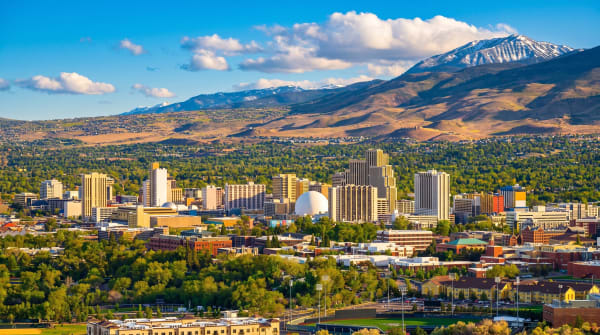
Las Vegas Area
21 communities
No state income tax on retirement income & world-class 55+ communities from Summerlin to Henderson — See why retirees are choosing the Las Vegas area
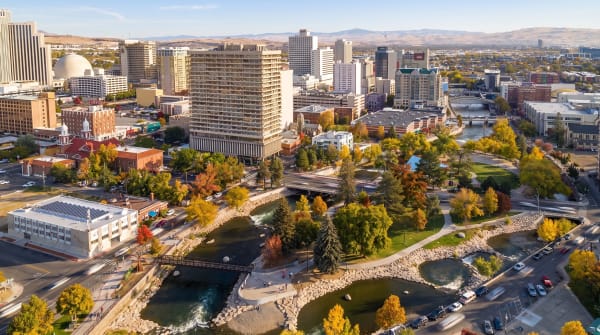
Reno / Northern NV
6 communities
High-desert sister city to Lake Tahoe with no state income tax and four real seasons — See why retirees are choosing Reno / Northern NV
Taxes for retirees in Nevada
Nevada's biggest retirement draw is its tax structure, and it is the single most-researched question among people considering a move here. There is no state income tax at all, which means Social Security, pensions, 401(k) and IRA withdrawals, and investment income are all untaxed at the state level. On a fixed retirement income, that math is meaningful — and it is the main reason retirees relocate here from California, Oregon, and the Midwest.
Property taxes are low by national standards. Nevada's effective property tax rate on owner-occupied homes is about 0.50%, well under half the U.S. average, and the state layers on an unusually helpful protection: under NRS 361.4723, the tax bill on your primary residence can rise no more than 3% per year regardless of how much the home's assessed value climbs. Non-primary residences (second homes, rentals) are capped at 8%. There is no age-based senior exemption in Nevada — the 3% cap does the heavy lifting instead, and long-tenure owners in Summerlin and Henderson end up paying noticeably less than the neighbor who just closed on an identical house. Watch the paperwork: the 3% cap is not automatic on a new purchase. You have to sign and return the primary-residence claim from your county assessor after closing, and missing it drops you to the 8% cap.
The tradeoff is sales tax. Because the state collects no income tax, sales tax is on the higher side — the base state rate is 6.85%, and combined state-and-local rates run 7.10% to 8.375%, with Clark County (Las Vegas / Henderson) at 8.375% and Washoe County (Reno) at 8.265%. You feel that at the register. Rounding out the picture: no estate tax, no inheritance tax, and no tax on gifts, which makes Nevada attractive for legacy planning as well as day-to-day cash flow.
Nevada climate & weather
If the question is which city in Nevada has the best year-round weather, the honest answer depends on your tolerance for heat versus your tolerance for snow. Southern Nevada — the Las Vegas valley, Henderson, and Mesquite — is classic hot, dry Mojave desert with roughly 290+ sunny days a year. Summers are intense, with long stretches of triple-digit heat from June into September and highs regularly clearing 105°F in July, but the humidity is low, mornings and evenings cool off faster than in the muggy Southeast, and air conditioning is simply a way of life. The reward is the other eight months: mild, sunny winters with daytime highs in the 55–65°F range, almost no rain, and near-perfect conditions for golf, hiking Red Rock, and pickleball from October through May.
Northern Nevada — Reno-Sparks, Sparks, and Carson City — is a four-season high-desert climate at roughly 4,500 feet at the foot of the Sierra. Winters are genuinely cold with periodic snow (though the valley floor gets far less than the mountains right behind it), summers are warm but rarely brutal with highs in the 90s and cool nights, and shoulder seasons are crisp and dry. Retirees who cannot tolerate 110°F but still want sunshine, dry air, and no income tax generally land here. Humidity stays low statewide, so wherever you settle in Nevada you can expect dry air and abundant blue-sky days.
Cost of living in Nevada
Nevada's overall cost of living sits within a few percentage points of the national average — most indices place the state between 99 and 103 — with housing as the swing factor. Against coastal California, from which the largest share of relocating buyers arrive, Las Vegas runs roughly 15–20% cheaper before the no-income-tax advantage is even counted, which is exactly why that move is so common.
Read moreShow less
Housing runs different in each region. In the Las Vegas valley, the average home value is around $425,000, with Henderson's median closer to $505,000–$515,000 as buyers pay for schools, master-planned amenities, and Summerlin/Green Valley addresses. Reno is meaningfully pricier — the average home value is around $577,000, reflecting the Sierra premium and steady in-migration from the Bay Area. Mesquite is the value play in the south, and Sparks and outlying Washoe County soften Reno-area pricing. In the established 55+ communities you will find a wide spread, from attached villas and smaller single-family designs in the low-$400s up through golf-course and custom homes well into the seven figures.
Retiree-specific realities: property tax bills are low (the average Clark County homeowner pays under $2,000 annually), and the 3% cap protects long-term budgets. Utilities cut the other way — summer cooling bills in the south are a real line item, running noticeably above the national average from June through September, and gasoline typically runs 15–25% above the national average. Healthcare is adequate and steadily improving, with major systems (HCA/MountainView, Intermountain, University Medical Center, and Renown in Reno), though retirees coming from large coastal cities notice the specialty-care bench is not quite as deep. And be honest about the desert realities: long-term water supply across the Colorado River basin is an ongoing regional concern worth factoring into any long-hold purchase.
How much do you need to retire in Nevada? For a comfortable, mortgage-free retirement, most planners land in the $55,000–$70,000 annual spend range for a couple in the Las Vegas valley, more in Reno, less in Mesquite or the smaller Washoe communities — with the no-income-tax advantage meaning you keep more of every dollar you draw from retirement accounts.
Pros of retiring in Nevada
- No state income tax on Social Security, pensions, IRAs, 401(k)s, or investment income
- No estate tax, no inheritance tax, and no gift tax
- Owner-occupied property tax increases capped at 3% per year (NRS 361.4723)
- Effective property tax rate around 0.50%, well below the national average
- Abundant sunshine — roughly 290+ sunny days a year in southern Nevada
- Dry, low-humidity climate statewide
- Large, established active adult communities including Sun City Summerlin, Sun City Anthem, Sun City Aliante, and Solera
- Del Webb and other builders continue opening new 55+ neighborhoods across the Las Vegas valley
- Strong relative value compared with neighboring California, especially on housing
- World-class dining, shows, sports, and entertainment in the Las Vegas valley
- Henderson consistently ranked among the safest large U.S. cities
- Excellent golf woven directly into many 55+ communities
- Harry Reid International Airport in Las Vegas makes travel and family visits easy
- Easy access to Lake Tahoe, the Sierra Nevada, and year-round outdoor recreation from Reno
- No-snow winters in the south for year-round outdoor living and golf
Things to consider
- Extreme summer heat in the south, with long stretches of triple-digit days from June into September
- High summer air-conditioning costs and above-average utility bills
- Combined sales tax on the higher side (up to 8.375% in Clark County) to offset the lack of income tax
- Gasoline routinely runs 15–25% above the national average
- Long-term Colorado River water supply is a real regional concern
- Healthcare depth thinner than in major coastal metros — some specialty care means traveling out of state
- Desert landscape is not for everyone if you want lush, green surroundings
- Real winters with snow and cold in Reno, Sparks, and Carson City
- Tourism traffic, construction, and rapid growth in the Las Vegas valley wear on some residents
- Strong in-migration has pushed prices up in the most popular 55+ areas over the past five years
- No age-based senior property tax exemption — the 3% cap is the only structural relief
55+ communities in Nevada: common questions
How many 55+ communities are in Nevada?
There are 27 active adult and 55+ communities in Nevada featured on Explore55Plus, with real photos, pricing, amenities, and resident insights for each.
How much do homes in 55+ communities in Nevada cost?
Homes in retirement and active adult communities in Nevada range from $100K to $1M, depending on the community, home type, and whether it's a new build or resale.
Are all 55+ communities in Nevada age-restricted?
No. Of the 27 communities in Nevada, 25 are age-restricted (typically one resident 55+) and 2 are open to all ages — so you can choose either an age-restricted or an all-ages active adult community.
Are there new-construction 55+ communities in Nevada?
Yes — 9 of the 27 communities in Nevada have new-construction homes available, alongside resale options in established neighborhoods.