
The Best Places to Retire in Missouri
15 cities ranked · 4 communities across 2 regions
Every Missouri retirement city, scored on 20 years of hourly weather, an itemized cost of living, and a happiness index built from federal data — then re-ranked live around your budget and ideal temperatures. When a city clicks, explore the 55+ communities inside it.
Missouri's cities, ranked for retirees
Updated August 25, 2026 · how we rank →
15 cities across Missouri · ranked for a typical buyer
Found a place you like?
Create a free account to explore the 55+ communities inside these cities — photos, pricing, amenities, and a matching quiz.
Retiring in Missouri
Missouri sits squarely in the heart of the country, and that central location shapes a lot of what makes it appealing to people asking whether it's a good place to retire. The state is anchored by two big metros on opposite corners. Greater St. Louis has the established suburbs spreading west into St. Charles County and south into Jefferson County, plus BJC HealthCare and SSM Health for medical depth. Greater Kansas City straddles the state line, with master-planned active adult communities multiplying in Lee's Summit, Liberty, Parkville, and the Northland — anchored by Saint Luke's and the University of Kansas Health System just across the border. These two regions hold the bulk of the medical centers, cultural amenities, and newer-construction 55+ communities, which is why most retirees start their search there.
Read moreShow less
Down in the southwest, Springfield has quietly become one of the best places to retire in Missouri, in large part because of its proximity to Branson and Table Rock Lake. Branson's live shows, lake recreation, and genuinely affordable housing draw active adults who want entertainment and water without coastal price tags. Missouri's other signature draw is the Lake of the Ozarks, a sprawling reservoir near the center of the state that's long been a vacation and second-home destination — plenty of folks who first came for summer weekends end up retiring there full-time.
The money story got dramatically better in the last two years. Missouri no longer taxes Social Security benefits at any income level, and as of the 2025 tax year it became the first state with an income tax to fully exempt individual capital gains — which quietly matters a lot to retirees selling a longtime home or drawing down a taxable brokerage account. Combined with a cost of living about 11% below the national average and median home prices near $240,000, retirement dollars stretch noticeably further than they do in Florida, Arizona, or the Carolinas.
The trade-offs are honest ones: four real seasons instead of endless summer, humid Julys, and a legitimately active tornado season that put Missouri third in the country for confirmed tornadoes in 2025. If you want lake-and-show country, Midwest pacing, easy family reach across the country, and a tax code that finally treats retirees well, retiring in Missouri deserves a serious look — and Greater Kansas City and Greater St. Louis are the two Area pages to explore first.
Explore Missouri by region
Dive into 55+ communities by region — each guide covers local amenities, pricing, and what makes the area a fit for retirees.
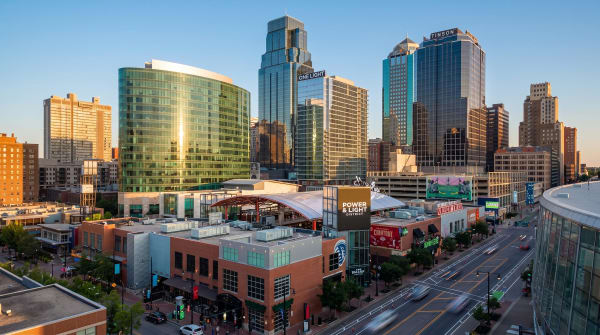
Greater Kansas City
2 communities
Heart of America metro with barbecue, jazz, and Midwest affordability — See why retirees are choosing Greater Kansas City

Greater St. Louis
2 communities
Big-city amenities at Midwest prices, no state tax on Social Security, and Forest Park in your backyard — see why retirees are choosing Greater St. Louis
Taxes for retirees in Missouri
Missouri has gotten dramatically friendlier to retirees in the last two years, and the changes are bigger than most listicles have caught up to. As of the 2024 tax year, the state no longer taxes Social Security benefits at all for anyone 62 or older — the old income phase-out is gone, so 100% of your Social Security is exempt at the state level no matter how high your other income runs. Then in July 2025, Governor Kehoe signed House Bill 594, making Missouri the first state in the nation with an income tax to fully exempt individual capital gains. Effective January 1, 2025, you deduct 100% of federally reported capital gains — stocks, bonds, real estate, crypto — when calculating Missouri taxable income. For a retiree selling a longtime home or drawing down a taxable brokerage account, that's real money.
Other retirement income is treated less generously, and this is where the fine print matters. Public pensions (federal, state, or local government service from any state) are exempt up to roughly the maximum Social Security benefit — $47,633 for 2025 — but that exemption is reduced dollar-for-dollar by any Social Security deduction you claim. Private pensions, traditional IRAs, and 401(k) withdrawals get only a modest exemption of about $6,000 per taxpayer, and anything above that is taxed as ordinary income. Missouri's top rate is 4.7% for 2025 (down from 4.8%), applied across eight graduated brackets, with a statutory target of 4.5%. Worth flagging for anyone eyeing a KC or STL address: both Kansas City and St. Louis levy a 1% local earnings tax on residents and workers, which the surrounding suburbs do not.
Property taxes are moderate nationally — residential real estate is assessed at 19% of true value — and the Senate Bill 190 senior freeze is now widely available. The freeze caps a primary-residence property tax bill at the qualifying-year level for homeowners eligible for Social Security, and adoption has spread to roughly 85 counties covering more than 80% of Missouri seniors, including the big ones (St. Louis, St. Louis City, Jackson, Clay, St. Charles, Greene). It's still county-by-county, so confirm current adoption and application windows with the county collector before you assume it applies. Missouri also has no estate tax and no inheritance tax, which simplifies planning for many families.
Missouri climate & weather
Missouri delivers four distinct seasons, and it means it. Summers are warm to hot and notably humid, with stretches of muggy 90-degree days that send most people indoors or out to the lake. Winters are cold-ish rather than brutal — periodic snow and ice, occasional single-digit cold snaps, but nothing like the prolonged deep freeze of the upper Midwest. Spring and fall are the payoff seasons that many residents consider the best part of the year, with Ozark foliage running vivid through October.
Because Missouri sits where warm Gulf air meets cooler northern systems, severe weather is real. The state averages 35 to 45 tornadoes a year historically, but has been unusually active lately — 93 confirmed tornadoes in 2024 and 98 in 2025, when Missouri ranked third in the country and an EF3 tore through the St. Louis metro on May 16. April through June is peak season. It's worth asking about storm shelters or safe rooms when you tour a community, and understanding that homeowners insurance in Missouri runs above the national average largely because of hail and wind claims.
Cost of living in Missouri
Cost of living in Missouri runs about 11% below the national average — the MERIC composite index sat at 88.6 for the first quarter of 2026, tying Missouri for the seventh-lowest cost of living in the country. Housing is the biggest driver: the statewide median home price is roughly $240,700, more than $170,000 below the national median, and the housing sub-index runs about 17% below the U.S. norm. In markets like Springfield, Joplin (index 83.7, the state's cheapest), and the Branson corridor, your money goes especially far; the St. Louis and Kansas City suburbs cost a bit more but still represent strong value for newer 55+ construction.
Read moreShow less
Day-to-day expenses track below the national norm too. Utilities run about 10% under average, groceries about 1% under, healthcare services about 5% under. Property taxes are moderate — residential is assessed at 19% of true value, and the county-adopted SB 190 senior freeze can cap your bill once you qualify. The one line item that runs hot is homeowners insurance, which is priced up for hail, wind, and tornado exposure.
For a specific anchor on the common question — how much you need to retire comfortably in Missouri — a couple owning a home outright in a mid-market suburb of Kansas City, St. Louis, or Springfield can generally live comfortably on $55,000 to $70,000 a year once Social Security and Medicare are in play, less if you're outside the metros. That's before the Social Security exemption and capital-gains repeal, both of which quietly raise real spending power.
Healthcare access is strong in the St. Louis metro (BJC, SSM, Mercy) and Kansas City metro (Saint Luke's, University of Kansas Health System, HCA Midwest), and solid around Springfield (CoxHealth, Mercy) and Columbia (University of Missouri Health). It thins out meaningfully in rural areas and around parts of the Lake of the Ozarks, which is worth weighing if you're considering a lake community more than 45 minutes from a major hospital.
Pros of retiring in Missouri
- Cost of living about 11% below the national average, seventh-lowest in the U.S.
- Social Security benefits fully exempt from state income tax for anyone 62 or older, with no income cap
- First state with an income tax to fully exempt individual capital gains as of 2025 — meaningful for retirees selling a home or drawing down a taxable brokerage account
- No estate tax and no inheritance tax
- Senate Bill 190 senior property-tax freeze now adopted in roughly 85 counties covering 80%+ of Missouri seniors, including the major metros
- Median home price around $240,700 — well below Sun Belt comparables
- Genuinely affordable 55+ and active adult housing, especially in Springfield, Branson, and the Ozarks
- Lake of the Ozarks and Table Rock Lake for boating, fishing, and full-time waterfront living
- Branson's live entertainment and lake recreation at Midwest prices
- Strong healthcare in St. Louis (BJC, SSM, Mercy) and Kansas City (Saint Luke's, University of Kansas Health System)
- Central U.S. location that keeps family across the country within easy driving or one-flight reach
- Top income tax rate down to 4.7% and still trending toward a 4.5% statutory target
- Four real seasons for retirees who don't want endless summer
Things to consider
- Hot, humid summers that make July and August feel oppressive
- One of the most tornado-active states in the country — 93 confirmed tornadoes in 2024, 98 in 2025, with an EF3 through the St. Louis metro that May
- Homeowners insurance runs above the national average because of hail and wind exposure
- Cold-ish winters with periodic snow, ice, and occasional single-digit stretches
- Private pensions, IRA, and 401(k) withdrawals get only a modest ~$6,000 exemption — this is the fine print that trips up retirees expecting the Social Security treatment to extend to everything
- Kansas City and St. Louis both levy a 1% local earnings tax on residents (suburbs do not)
- SB 190 senior property-tax freeze is still county opt-in — confirm adoption before you assume it applies
- Healthcare access thins out in rural areas and parts of the Lake of the Ozarks
- Missouri Medicaid (MO HealthNet) is widely criticized for access and responsiveness if you'll rely on it for long-term care
- Fewer beaches-and-palm-trees amenities than the Sun Belt retirement picture
55+ communities in Missouri: common questions
How many 55+ communities are in Missouri?
There are 4 active adult and 55+ communities in Missouri featured on Explore55Plus, with real photos, pricing, amenities, and resident insights for each.
How much do homes in 55+ communities in Missouri cost?
Homes in retirement and active adult communities in Missouri range from $200K to $550K, depending on the community, home type, and whether it's a new build or resale.
Are all 55+ communities in Missouri age-restricted?
No. Of the 4 communities in Missouri, 3 are age-restricted (typically one resident 55+) and 1 is open to all ages — so you can choose either an age-restricted or an all-ages active adult community.
Are there new-construction 55+ communities in Missouri?
Yes — 2 of the 4 communities in Missouri have new-construction homes available, alongside resale options in established neighborhoods.