
The Best Places to Retire in Massachusetts
19 cities ranked · 19 communities across 2 regions
Every Massachusetts retirement city, scored on 20 years of hourly weather, an itemized cost of living, and a happiness index built from federal data — then re-ranked live around your budget and ideal temperatures. When a city clicks, explore the 55+ communities inside it.
Massachusetts's cities, ranked for retirees
Updated August 25, 2026 · how we rank →
19 cities across Massachusetts · ranked for a typical buyer · 17 demoted over your $375k home budget
Found a place you like?
Create a free account to explore the 55+ communities inside these cities — photos, pricing, amenities, and a matching quiz.
Retiring in Massachusetts
Massachusetts packs enormous variety into a compact state, and where you land shapes the retirement you'll have. It's not the obvious Sun Belt choice. You'll pay a premium and shovel snow. But for retirees who want world-class hospitals, walkable New England towns, and four real seasons within a two-hour drive of the coast, the mountains, and Boston, it's one of the best places to retire in Massachusetts terms that actually mean something.
Read moreShow less
Greater Boston and the MetroWest suburbs (Framingham, Natick, Acton, Westborough, and North Shore towns like Newburyport, Beverly, and Cape Ann) draw 55+ buyers who want Mass General or Brigham and Women's twenty minutes away, commuter-rail access, and a short drive to grandchildren, culture, and Logan Airport. This is where the densest cluster of active adult communities sits: low-maintenance condos and villas with clubhouses, walking trails, and resident-run calendars. It's also where retirement communities in Massachusetts command the state's highest prices.
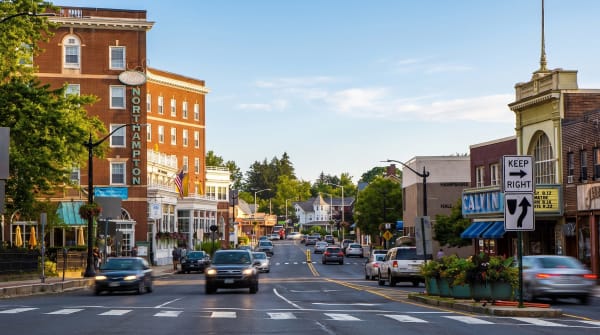
Western MA and the Connecticut River Valley trade the ocean for mountains, cultural festivals, college-town energy around Northampton and Amherst, and a quieter pace at prices that make Boston look absurd. The Berkshires have Tanglewood summers and postcard foliage; the Pioneer Valley has real downtowns and world-class healthcare through Baystate Health without the Boston price tag. Cape Cod and the South Shore remain the marquee coastal draw. Barnstable was one of the top inbound relocation markets in the country in 2025, but expect million-dollar medians in the most desirable Cape towns.
The through-line is lifestyle over acreage: 55+ buyers here choose walkability, healthcare, and proximity to family over year-round golf, and they don't mind paying for it. It suits people who'd rather have a sweater-weather autumn and a Boston specialist forty minutes away than a Villages-style master plan. If that's you, Massachusetts is a good place to retire, with clear-eyed acknowledgment that it's also one of the most expensive.
Explore Massachusetts by region
Dive into 55+ communities by region — each guide covers local amenities, pricing, and what makes the area a fit for retirees.

Greater Boston / Eastern MA
19 communities
World-class healthcare, Ivy League brainpower, and four-season New England charm — See why retirees are choosing Greater Boston
Western MA / Connecticut River Valley
2 communities
Five Colleges, Tanglewood, and the Berkshires without Boston prices — See why retirees are choosing Western Mass and the Connecticut River Valley
Taxes for retirees in Massachusetts
Massachusetts taxes individual income at a flat 5%, and the friendly headline for retirees is that the state does not tax Social Security benefits. The less friendly news: most other retirement income (pension distributions, 401(k) and IRA withdrawals) is taxed at that 5% rate, though Massachusetts state and local government pensions (and certain other states' public pensions) are exempt. Sales tax is a flat 6.25%, with clothing under $175 per item and most groceries exempt.
A newer wrinkle for higher-income retirees: the 4% "millionaires" surtax on income above an inflation-adjusted threshold. That threshold is $1,083,150 for 2025 and $1,107,750 for 2026. It's marginal, not a cliff, so only dollars above the line get hit with the extra 4%. The real trap for retirees isn't a high salary; it's a one-time spike. A business sale, a large Roth conversion, or a highly appreciated home sale can push a single year over the threshold. Time those events across tax years and most retirees never touch it.
Property taxes are the bigger day-to-day story. The statewide effective rate averages around 1.23%, and mill rates vary dramatically by town, from under $5 per $1,000 in some Berkshire towns to over $20 in parts of Western MA. The state's Senior Circuit Breaker credit refunds up to $2,820 for tax year 2025 to homeowners 65+ whose property tax plus half their water/sewer exceeds 10% of income (income caps: $75,000 single, $94,000 head of household, $112,000 joint; home assessed value must be under $1,298,000). Most towns also offer senior exemptions and deferrals on top.
The honest caveat for estate planning: Massachusetts has one of the country's most aggressive state estate taxes. The exemption rose from $1 million to $2 million in 2023, a real improvement, but it still sits far below the federal $13.99 million threshold and functions largely as a cliff at $2 million, with rates up to 16%. A paid-off house in a desirable town plus retirement accounts and life insurance can quietly push an estate over the line. Anyone with net worth approaching seven figures should talk to a Massachusetts estate attorney; it's one of the most-cited reasons some retirees ultimately decamp to Florida or New Hampshire.
Massachusetts climate & weather
Massachusetts has four genuine, distinct seasons. Summers are warm and humid, generally in the 80s, with the coast and the Cape running noticeably cooler and breezier thanks to ocean moderation. That's one reason the Cape fills up from June through September. Autumn is the showstopper: crisp air and brilliant foliage that draw visitors from around the world.
Winters are cold and snowy, with January highs often near freezing and nor'easters capable of dropping a foot or more of snow at a time. The Berkshires see the deepest snow; the immediate coast tends to run a few degrees milder and sometimes gets rain where inland gets snow. Ice storms are the underrated hazard. Power outages happen, and heating bills for a New England winter are real money on top of already high utility costs. If you love distinct seasons, that's a feature; if you dread shoveling, it's the main reason many Massachusetts retirees become snowbirds.
Cost of living in Massachusetts
There's no soft-pedaling this: Massachusetts consistently ranks among the two or three most expensive states in the country, and housing is the biggest reason. The statewide cost-of-living index runs roughly 30-48% above the national average depending on the source, with housing alone running about twice the national number.
Read moreShow less
In specifics: the statewide median single-family sale price hit $638,000 in 2025, up 3.7% from the prior year, according to Warren Group data. In Greater Boston, the median single-family price crossed $1 million in mid-2025 and held there. More than 50 Massachusetts cities and towns had 2025 median sale prices above $1 million, and nine cleared $2 million. Active adult condos and villas in the desirable Boston suburbs, the North Shore, and Cape Cod commonly run into the high six figures, with the most sought-after coastal and MetroWest addresses pushing past a million. The statewide condo median in 2025 was $537,000, often the more realistic entry point for right-sizing retirees.
Where the math gets friendlier: Central Massachusetts around Worcester, the Pioneer Valley (Northampton, Amherst, South Hadley), and parts of the Berkshires. In Berkshire and Pioneer Valley towns, medians in the $400,000s are still normal, and property tax bills, while rates are high, apply to a much smaller assessed value.
Everything else (utilities at roughly 49% above national, groceries, services) tends to sit above the national average too. What you get in return is genuine retiree value: Boston is a global center of medicine, with Mass General, Brigham and Women's, Dana-Farber, Beth Israel Lahey, and Tufts Medical Center all within reach, meaning top-tier specialists and research hospitals are close at hand no matter which corner of eastern Massachusetts you choose. For buyers who prioritize healthcare and family proximity, many decide the premium is worth it, but be honest with yourself about the math before committing.
How much do you need to retire comfortably in Massachusetts? There's no single number, but comfort in eastern MA typically requires meaningfully more than the national retiree median. Think a paid-off home plus $70,000-$100,000 in annual spending capacity for a couple who wants to travel, eat out, and cover a Medigap plan. In the Pioneer Valley or Central Mass, that same lifestyle runs closer to the national norm.
Pros of retiring in Massachusetts
- Massachusetts does not tax Social Security benefits
- World-class healthcare anchored by Mass General, Brigham and Women's, Dana-Farber, and Beth Israel Lahey
- A flat, simple 5% state income tax with no bracket creep
- Senior Circuit Breaker credit refunds up to $2,820 in property taxes for qualifying 65+ residents
- Cape Cod, the Islands, and an extensive coastline within easy reach
- Walkable, historic New England towns with real downtowns
- World-renowned universities, museums, theater, and music
- Four distinct seasons, including spectacular fall foliage
- Clothing (under $175 per item) and most groceries are exempt from sales tax
- Strong public services, libraries, and senior centers in most towns
- Proximity to family for many long-rooted New Englanders
- A dense selection of active adult communities in Boston suburbs and on the Cape
- Barnstable and Cape Cod continue to rank among the country's top inbound retiree markets
Things to consider
- Very high cost of living, among the two or three most expensive states, roughly 30-48% above the national average
- Statewide median single-family home price hit $638,000 in 2025; the Greater Boston median crossed $1 million
- Cold, snowy winters with nor'easters, ice storms, and high heating bills
- The Massachusetts estate tax exemption is $2 million, well below the federal $13.99 million threshold, and functions largely as a cliff with rates up to 16%
- Most retirement income (pensions, 401(k), IRA withdrawals) is taxed at 5%
- Property tax rates vary widely by town and are high in absolute-dollar terms on high-value homes
- Utilities run roughly 49% above the national average
- Massachusetts ranked 5th nationally for domestic outmigration in 2025, with cost of living and taxes as the cited reasons
- Summer traffic and crowds on Cape Cod, the Islands, and the coast
- Humid, sticky summers inland
- Limited new-construction land near desirable suburbs keeps inventory tight and prices sticky
- The 4% surtax can surprise retirees selling a home or completing a large Roth conversion in a single year
55+ communities in Massachusetts: common questions
How many 55+ communities are in Massachusetts?
There are 19 active adult and 55+ communities in Massachusetts featured on Explore55Plus, with real photos, pricing, amenities, and resident insights for each.
How much do homes in 55+ communities in Massachusetts cost?
Homes in retirement and active adult communities in Massachusetts range from $300K to $1M, depending on the community, home type, and whether it's a new build or resale.
Are all 55+ communities in Massachusetts age-restricted?
No. Of the 19 communities in Massachusetts, 17 are age-restricted (typically one resident 55+) and 2 are open to all ages — so you can choose either an age-restricted or an all-ages active adult community.
Are there new-construction 55+ communities in Massachusetts?
Yes — 9 of the 19 communities in Massachusetts have new-construction homes available, alongside resale options in established neighborhoods.