
The Best Places to Retire in Maryland
15 cities ranked · 36 communities across 3 regions
Every Maryland retirement city, scored on 20 years of hourly weather, an itemized cost of living, and a happiness index built from federal data — then re-ranked live around your budget and ideal temperatures. When a city clicks, explore the 55+ communities inside it.
Maryland's cities, ranked for retirees
Updated August 25, 2026 · how we rank →
15 cities across Maryland · ranked for a typical buyer · 11 demoted over your $375k home budget
Found a place you like?
Create a free account to explore the 55+ communities inside these cities — photos, pricing, amenities, and a matching quiz.
Retiring in Maryland
Maryland packs an unusual amount of variety into a small footprint, and that variety is exactly why retiring in Maryland appeals to so many 55+ buyers. In the span of a couple of hours you can go from the Appalachian foothills in the west, across the rolling Piedmont and the densely populated I-95 corridor, down to the flat tidal farmland and beaches of the Eastern Shore. If you're weighing whether Maryland is a good place to retire, that range is the honest answer: you can chase very different lifestyles without leaving the state, all while staying close to the cultural and medical heavyweights of Washington, D.C., and Baltimore.
Read moreShow less
The best places to retire in Maryland cluster into three regions worth exploring in this order. Baltimore / Central Maryland puts you inside the Johns Hopkins and University of Maryland medical orbit, with more moderate housing than the D.C. side and easy Amtrak access up and down the Northeast Corridor. The DC Suburbs / Southern Maryland region — Montgomery, Howard, Anne Arundel, and the lower Potomac and Patuxent counties — is where you'll find the highest-cost active adult product, but also walkable town centers, top hospitals, and the sailing-town lifestyle around Annapolis and the Chesapeake Bay. The Eastern Shore is the value play and a genuine coastal retirement destination, from Ocean City and the planned community of Ocean Pines to quieter Bay-side towns where beach access, golf, and waterfront living come at prices well below the D.C. suburbs.
The money story is mixed and worth understanding up front. Maryland does not tax Social Security, offers a pension exclusion of up to $41,200 for residents 65+, and layers on a separate senior tax credit of up to $1,750 — but every county piggybacks a local income tax of up to 3.30% on top of the state rate, and Maryland is the only state in the country with both an estate tax and an inheritance tax. The climate trade-off is simpler: four genuine seasons, humid summers, and mild-to-cold winters that get snowier the further west you go.
Maryland tends to suit retirees who don't want to give up access to a real city, world-class medicine, and four distinct seasons in exchange for retirement. It's a strong fit for people who value culture and connectivity over rock-bottom costs, and for those who want the option of both bay-and-beach relaxation and big-city amenities depending on the day.
Explore Maryland by region
Dive into 55+ communities by region — each guide covers local amenities, pricing, and what makes the area a fit for retirees.

Baltimore / Central MD
12 communities
DC Suburbs / Southern MD
18 communities
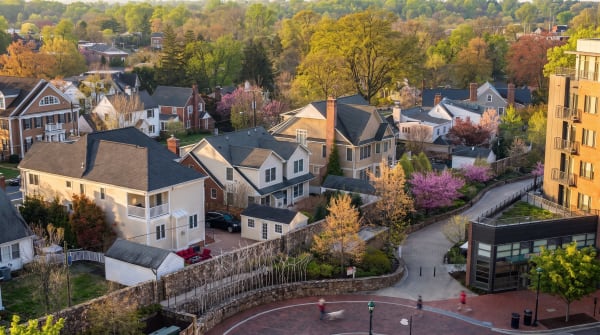
Federal-hub suburbs with world-class healthcare, Chesapeake waterfronts & tax-free Social Security — See why retirees are choosing the DC Suburbs & Southern MD

Eastern Shore MD
6 communities
Chesapeake Bay waterfront towns, no tax on Social Security & four true seasons — See why retirees are choosing Maryland's Eastern Shore
Taxes for retirees in Maryland
Maryland taxes for retirees are an honest case of mixed news. On the plus side, the state does not tax Social Security benefits at all, and residents 65 and older can qualify for a pension exclusion of up to $41,200 for tax year 2025 on income from qualified employer plans like pensions, 401(k)s, 403(b)s, and 457(b)s. Two important catches: the exclusion is reduced dollar-for-dollar by Social Security benefits received, and it does not apply to traditional IRA distributions — which means rolling a 401(k) into an IRA at retirement can quietly eliminate eligibility. On top of that, a Maryland senior tax credit gives residents 65+ a nonrefundable credit of up to $1,000 (single) or $1,750 (joint) when federal adjusted gross income stays under $100,000/$150,000. Military retirees 55+ can subtract up to $20,000 of military retirement income separately.
The catch is the rest of the tax picture. Maryland's state income tax is graduated from 2% to 5.75%, with two new high-income brackets of 6.25% and 6.50% added in 2025 for taxable income above $500,000 and $1 million (single). Higher earners should also watch a new 2% surtax on net capital gains when federal AGI exceeds $350,000. The bigger everyday bite is the local "piggyback" income tax that every county and Baltimore City layers on top, now allowed up to 3.30% after a 2025 rate-cap increase. Those local rates are real money and are easy to overlook when you compare states by headline rate alone. Property taxes are moderate and vary by county, and homeowners can soften them through the Homestead Tax Credit (which caps annual taxable-assessment increases) and the income-based Homeowners' Property Tax Credit, plus a separate state senior property tax credit for lower-income seniors and various county-level credits (Howard's 25% senior credit is one of the more generous). Sales tax is a flat 6% with no local add-ons and no tax on groceries.
The item to flag most clearly: Maryland is the only state in the country that levies BOTH an estate tax (exemption $5 million per person, top rate 16%) AND a separate inheritance tax (10% on bequests to anyone outside a defined family circle). Spouses, children, grandchildren, parents, grandparents, and siblings are exempt from the inheritance tax — but nieces, nephews, cousins, friends, and unrelated beneficiaries pay 10% with no exemption amount. Anyone leaving assets to non-lineal heirs should factor this in and plan accordingly.
Maryland climate & weather
Maryland has four genuine seasons. Summers are warm and notably humid, with stretches of heat and afternoon thunderstorms, while winters run mild to cold depending on where you are — snowier in the western mountains and milder along the coast. Spring and fall are the standouts: long, comfortable, and colorful.
The Chesapeake Bay and the Atlantic exert a real moderating effect on the eastern half of the state, taking the edge off both summer highs and winter lows near the water. Inland and to the west, expect colder winters and meaningful snow. For most 55+ buyers, the trade-off is straightforward: you get true seasons and East Coast fall foliage in exchange for some genuinely humid summer weeks and the occasional real winter.
Cost of living in Maryland
Maryland is one of the highest-income states in the country, and its cost of living runs above the national average to match, with housing the main driver. The statewide median home price sits around $431,000–$447,000 heading into 2026 — modestly up year over year and well above the national median.
Read moreShow less
What you pay depends heavily on which side of the state you land on. Montgomery County near D.C. runs about $618,000 at the median, Annapolis around $548,000, and Columbia in Howard County around $517,000 — and 55+ homes in those markets often start in the mid-to-high $400,000s and climb past $700,000 for newer active adult product. Head to Baltimore / Central Maryland outside the immediate D.C. orbit, or over to the Eastern Shore and the Ocean Pines area, or into Southern Maryland, and prices are meaningfully more moderate, frequently in the $300,000s to mid-$400,000s. That gap is a big part of why those regions dominate the "best places to retire in Maryland" conversation on a fixed budget.
A few retiree-specific costs worth naming. Property taxes are moderate but vary sharply by county, and effective rates hover just above 1%. Utilities and grocery costs track the national average more closely than housing does. And that local income tax of up to 3.30% keeps applying in retirement to any income the state can tax — pensions, IRA withdrawals, and the taxable slice of your 401(k) that exceeds the pension exclusion. Buyers often ask whether it's cheaper to live in a 55+ community than a standard home: the sticker price usually isn't lower, but the HOA typically bundles lawn care, exterior maintenance, and amenity access that would otherwise be separate line items — so the real comparison is total monthly cost, not purchase price alone.
What you get in return is access to some of the best healthcare in the nation. Johns Hopkins in Baltimore and the University of Maryland Medical System anchor a deep bench of hospitals and specialists, and the broader D.C.–Baltimore medical corridor means top-tier care is rarely far away — a meaningful factor for retirees weighing long-term health needs.
Pros of retiring in Maryland
- No state tax on Social Security benefits
- Pension exclusion up to $41,200 (2025) for residents 65+ from 401(k)s, 403(b)s, and pensions
- Separate Maryland senior tax credit worth up to $1,750 for joint filers 65+ under the income cap
- World-class healthcare, including Johns Hopkins and the University of Maryland Medical System
- Chesapeake Bay lifestyle with boating, crab feasts, and waterfront living
- Atlantic beaches at Ocean City and the Ocean Pines retirement community
- Easy proximity to Washington, D.C., and Baltimore culture, museums, and theater
- Four distinct seasons with long, scenic springs and falls
- Wide range of settings, from mountains to city suburbs to coast, in a compact state
- More affordable retirement options on the Eastern Shore, in Southern Maryland, and outside the D.C. orbit
- Strong airport and transit access via BWI, plus Amtrak and the Northeast Corridor
- Military retirees 55+ can subtract up to $20,000 of military retirement pay
Things to consider
- High overall tax burden once local income taxes are included
- County "piggyback" income taxes now allowed up to 3.30% on top of state income tax
- The only U.S. state with BOTH an estate tax ($5M exemption) and an inheritance tax (10% to non-lineal heirs)
- Two new state income tax brackets (6.25% and 6.50%) and a 2% capital gains surtax over $350K FAGI added in 2025
- High cost of living and pricey housing in the D.C. and Annapolis suburbs
- Heavy traffic and congestion along the I-95 and Beltway corridors
- Hot, humid summers with frequent thunderstorms
- Pension exclusion is reduced dollar-for-dollar by Social Security and does NOT cover IRA distributions
- Winters can bring real cold and meaningful snow, especially in western Maryland
55+ communities in Maryland: common questions
How many 55+ communities are in Maryland?
There are 36 active adult and 55+ communities in Maryland featured on Explore55Plus, with real photos, pricing, amenities, and resident insights for each.
How much do homes in 55+ communities in Maryland cost?
Homes in retirement and active adult communities in Maryland range from $50K to $950K, depending on the community, home type, and whether it's a new build or resale.
Are all 55+ communities in Maryland age-restricted?
No. Of the 36 communities in Maryland, 34 are age-restricted (typically one resident 55+) and 2 are open to all ages — so you can choose either an age-restricted or an all-ages active adult community.
Are there new-construction 55+ communities in Maryland?
Yes — 13 of the 36 communities in Maryland have new-construction homes available, alongside resale options in established neighborhoods.