
The Best Places to Retire in Arizona
22 cities ranked · 92 communities across 5 regions
Every Arizona retirement city, scored on 20 years of hourly weather, an itemized cost of living, and a happiness index built from federal data — then re-ranked live around your budget and ideal temperatures. When a city clicks, explore the 55+ communities inside it.
Arizona's cities, ranked for retirees
Updated August 25, 2026 · how we rank →
22 cities across Arizona · ranked for a typical buyer · 18 demoted over your $375k home budget
Found a place you like?
Create a free account to explore the 55+ communities inside these cities — photos, pricing, amenities, and a matching quiz.
Retiring in Arizona
Arizona is the archetypal Sunbelt retirement state, and the reasons are concrete. It has a flat 2.5% state income tax, no tax on Social Security, no estate or inheritance tax, low property tax rates, and world-class healthcare anchored by Mayo Clinic-Phoenix, one of only 20 hospitals on the U.S. News Honor Roll nationally. Add 299 sunny days a year in the Valley, an enormous inventory of established 55+ communities, and a major-hub airport in Phoenix Sky Harbor, and the case retirees have been making for 60-plus years still holds.
Read moreShow less
The real question isn't whether Arizona is a good place to retire, for most retirees weighing warm-weather options, it clearly is, but which Arizona. This is a state of elevations, and the climate you'll actually live with depends entirely on where you land. The Phoenix metro divides into distinct retirement zones with different price points and personalities. The East Valley (Mesa, Chandler, Gilbert, Sun Lakes, Apache Junction) is the mainstream retiree corridor, with mature Del Webb and Robson communities and easy access to Sky Harbor. The West Valley (Sun City, Sun City West, Sun City Grand, Surprise, PebbleCreek, Goodyear, Buckeye) is where Del Webb invented the modern 55+ community in 1960 and where most of the state's affordable active-adult inventory still sits. Scottsdale and North Phoenix are the premium end: golf, resort dining, luxury Trilogy and gated communities, higher tax base, higher everything. Tucson and Green Valley run cooler than Phoenix, cost noticeably less, and have long been the value play, with SaddleBrooke, Quail Creek, and the Green Valley retirement corridor drawing retirees who want desert without the Valley's summer intensity. Prescott and northern Arizona are the high-country alternative: four seasons, pine forests, real winters with occasional snow, and summer highs in the 80s instead of 110s.
The tax story is straightforward. Social Security is untaxed. Everything else (IRA withdrawals, 401(k) distributions, private pensions) pays a flat 2.5%. Property taxes on a median home run roughly $1,800-$2,000 a year, with a 5% annual cap on assessed-value increases and a Senior Freeze program for income-qualified homeowners 65 and older. There's no estate tax, no inheritance tax, and Arizona's community property status delivers a full step-up in basis for surviving spouses.
The climate trade-off is where retirees need to be honest. Phoenix summers are not a Florida-style humid grind. They are dry, intense, and increasingly extreme, with 70 days over 110°F in 2024 and multi-week stretches where going outside between 10 a.m. and 8 p.m. is genuinely inadvisable. The winter payoff is spectacular: 70-degree Januarys, snowbird season from October to April. But summer is real, and it now comes with a second cost. Homeowners insurance has jumped roughly 70% over six years, driven by wildfire losses in the high country and rebuild costs across the state. Retirees who plan for the heat (efficient HVAC, backup cooling, summer travel or a cooler second base) do fine here. Those who don't get blindsided by the utility bills and the July reality. Arizona rewards retirees who pick the right elevation, budget honestly for insurance and utilities, and take advantage of a tax code that was arguably written with them in mind.
Explore Arizona by region
Dive into 55+ communities by region — each guide covers local amenities, pricing, and what makes the area a fit for retirees.
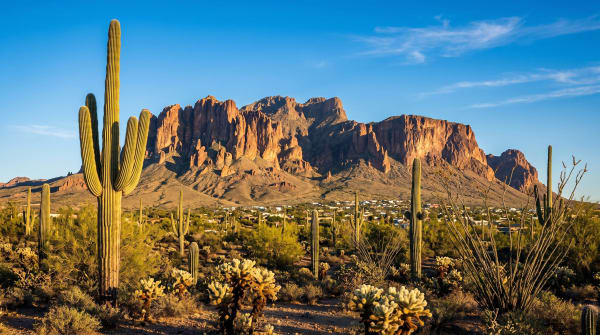
Phoenix - East Valley
25 communities
Sunbelt suburbs with walkable downtowns, top-tier golf & one of America's densest pickleball scenes — See why retirees choose Phoenix East Valley

Phoenix - West Valley
19 communities
Arizona's original retirement heartland — home to Sun City and America's biggest cluster of 55+ communities — See why retirees are choosing Phoenix's West Valley
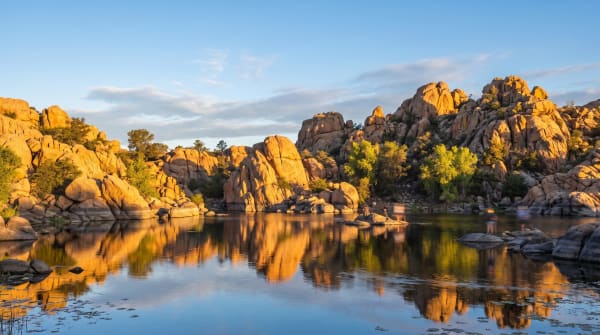
Prescott / Northern Arizona
10 communities
Mile-high mountain retreat at 5,300 feet with real four-season weather & 277 sunny days — See why retirees are choosing Prescott
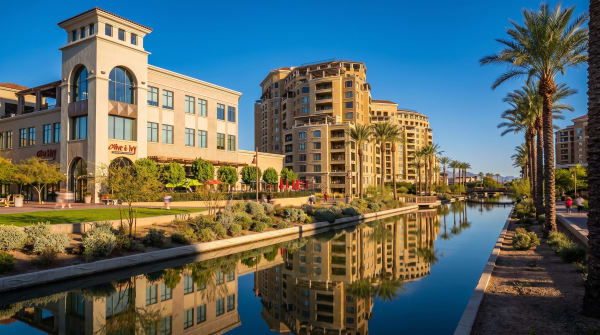
Scottsdale / North Phoenix
7 communities
Golf capital of the desert & world-class Mayo Clinic care under 300+ days of sun — See why retirees are choosing Scottsdale / North Phoenix
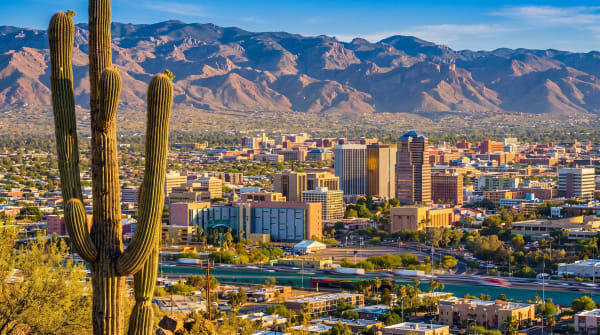
Tucson / Green Valley
35 communities
Dry-heat Sonoran Desert lifestyle with resort-caliber 55+ communities and no tax on Social Security — See why retirees are retiring in Tucson
Taxes for retirees in Arizona
Arizona lands in the tax-friendly-for-retirees camp, though it's not the giveaway some people expect. Social Security is fully exempt at the state level, regardless of income. Military retirement pay is also fully exempt. Everything else (traditional IRA and 401(k) withdrawals, private pensions, rental income, capital gains) pays Arizona's flat 2.5% income tax, one of the lowest rates in the country. Government pensions (federal, state of Arizona, or Arizona local) qualify for a subtraction of only the first $2,500, so most of a public pension is still taxed. There is no broad age-based exclusion for retirement income.
The estate picture is clean. Arizona has no state estate tax and no inheritance tax, and because it's a community property state, jointly owned assets get a full step-up in basis when one spouse dies, a meaningful benefit for surviving spouses selling a long-held home or brokerage account.
Property taxes are low, though the relief programs are narrow. Arizona's effective property tax rate runs roughly 0.45%-0.52% of market value, well below the national average, with a 5% annual cap on how much the Limited Property Value can rise on most homes. There is no broad senior homestead exemption. The main age-based break is the Senior Property Valuation Protection Option (the "Senior Freeze"), which locks the Limited Property Value used to calculate your tax for a renewable three-year term. You must be 65 or older, occupy the home as your primary residence, and meet an income limit that adjusts annually (2026 limits are roughly $47,712 for one owner and $59,640 for two or more, based on a three-year income average). The freeze holds the assessed value flat, but rates can still change, so the bill isn't literally frozen. Widow, widower, and disabled-person exemptions reduce assessed value by up to $3,000 for those who qualify. A narrow Property Tax Refund Credit (Form 140PTC) offers up to $502 for very-low-income seniors.
On the sales side, the state rate is 5.6%, but combined state-plus-local rates average around 8.2% and can reach 10% or higher in some jurisdictions. Groceries for home consumption and prescription drugs are exempt at the state level, though a handful of smaller cities still tax groceries locally. Phoenix, Mesa, Tucson, and Scottsdale do not. For most retirees drawing Social Security plus modest IRA withdrawals, Arizona's total tax bite lands well below high-tax states like California, New York, Illinois, or New Jersey, which is exactly why the migration into retirement communities in Arizona keeps happening.
Arizona climate & weather
Arizona is not one climate. It's at least three, and choosing the right elevation matters more than choosing the right community. The Phoenix metro sits around 1,100 feet in the Sonoran Desert and runs the extremes: 299 sunny days a year, roughly 9 inches of rain, and summers that are genuinely brutal. Phoenix logged 70 days at or above 110°F in 2024 and endured a record 31-day streak of 110°-plus highs in the summer of 2023. Heat season runs from late April through mid-October, with pre-monsoon June and July the most punishing. The North American Monsoon arrives in July and August, bringing dramatic thunderstorms, dust storms (haboobs), damaging winds, and flash flooding in normally dry washes. Valley winters are the payoff: highs in the 60s and 70s, cool nights, and the reason snowbirds fill the freeways from October through April.
Tucson sits about 1,300 feet higher (around 2,400 feet) and runs meaningfully cooler than Phoenix year-round, with more rain (roughly 12 inches), stronger monsoon storms, and a real four-season feel against the Santa Catalina Mountains. Prescott and northern Arizona are a different state entirely. Prescott sits near 5,400 feet, averages around 16 inches of rain plus winter snow, and summer highs typically top out in the 80s while Phoenix bakes at 110, which is why Prescott has been a Valley summer escape for a century. Flagstaff, higher still at 7,000 feet, gets full four-season winters with heavy snow. The trade-off in the high country is wildfire: peak fire season runs from late April through July, and homeowners in the wildland-urban interface around Prescott, Sedona, Payson, and Show Low are increasingly seeing non-renewals and steep insurance increases.
Cost of living in Arizona
Arizona's cost of living runs roughly 5-7% above the national average statewide, with the Phoenix metro landing around 6-13% above depending on the index, driven almost entirely by housing and summer utilities rather than by taxes or groceries.
Read moreShow less
Housing is the single biggest line. The median sale price in Phoenix was $465,000 as of late 2025, up modestly year-over-year and well above the pre-pandemic baseline, though off the 2022 peak. Scottsdale and North Phoenix run substantially higher. The East and West Valleys (Mesa, Chandler, Gilbert, Surprise, Buckeye, Goodyear) are where most new 55+ inventory sits at more workable price points. Tucson is meaningfully cheaper: one-bedroom rents run about $886 versus $1,124 in Phoenix, and Green Valley south of Tucson has long been one of the most affordable established retiree markets in the state. Prescott and Flagstaff carry mountain-town premiums; Flagstaff's median home price is around $700,000.
Property taxes are a genuine bright spot. The effective rate on a median-valued Arizona home works out to roughly $1,800-$2,000 per year, thanks to rates in the 0.45%-0.52% range and the 5% annual LPV cap.
Utilities are where the desert bill lands. Phoenix electric bills run around $200 per month annualized, but summer months can hit $350-$500 as air conditioning runs continuously from May through September. Budget for that, service the HVAC before summer, and keep a backup cooling plan. This is not optional in the Valley.
For retiree-specific costs: groceries and prescriptions are exempt from state sales tax, and healthcare is well-priced by national standards, with Phoenix medical costs running roughly 7% below the national average. The rising line item to watch is homeowners insurance. Average Arizona premiums have surged roughly 70% over the past six years and jumped 48% between 2021 and 2024, the third-largest state increase in the country, driven by wildfire losses, monsoon hail and wind, and construction-cost inflation. Rural and wildland-urban-interface areas (Prescott, Sedona, Payson, the White Mountains) are seeing non-renewals; even the Superstition and Cave Creek fringes of Maricopa County are affected.
Most 55+ communities in Arizona are HOA-governed, with monthly dues in the $150-$400 range covering rec centers, golf, and common-area upkeep. A handful of master-planned developments layer in Community Facilities District (CFD) assessments on top of standard property tax. Read the disclosures carefully: the sticker price on a Del Webb or Robson home is not the whole monthly nut.
Pros of retiring in Arizona
- No state tax on Social Security benefits, at any income level
- Flat 2.5% state income tax on IRA, 401(k), and pension withdrawals, one of the lowest rates in the nation
- Military retirement pay is fully exempt
- No state estate tax and no inheritance tax
- Community property state: jointly owned assets get a full step-up in basis when one spouse dies
- Low effective property tax rates (roughly 0.45%-0.52%) plus a 5% annual LPV cap
- Senior Property Valuation Protection Option can freeze assessed value for income-qualified homeowners 65 and older
- Groceries and prescription drugs exempt from state sales tax
- Mayo Clinic-Phoenix is on the U.S. News Honor Roll, one of only 20 hospitals nationally, anchoring a deep healthcare bench that includes Banner, HonorHealth, and Banner Boswell in Sun City
- Massive established inventory of retirement communities in Arizona: Sun City, Sun City West, Sun City Grand, Sun Lakes, PebbleCreek, Trilogy, Robson Ranch, and Del Webb's flagship Anthem communities
- Phoenix Sky Harbor is a major hub with nonstop service to nearly everywhere family lives
- 299 sunny days a year in Phoenix; winter highs in the 60s and 70s are the snowbird payoff
- Elevation options (from Sonoran Desert at 1,100 ft to Tucson at 2,400 ft to Prescott high country at 5,400 ft) let you choose the climate you can actually live with
- No hurricanes, no tornadoes to speak of, no salt-air corrosion on the house
Things to consider
- Summer heat is genuinely dangerous, not just uncomfortable. Phoenix logged 70 days over 110°F in 2024 and a 31-day streak of 110°-plus in 2023
- Electric bills in the Valley can hit $350-$500 in peak summer months; HVAC failure in July is a life-safety event
- Homeowners insurance premiums have jumped roughly 70% over six years and 48% from 2021 to 2024, the third-largest increase in the country
- Wildfire non-renewals and coverage limits are increasing in Prescott, Sedona, Payson, and the White Mountains, and creeping into wildland-urban-interface edges of Maricopa County
- Monsoon season brings haboobs, damaging winds, flash flooding, and hail
- Combined state-plus-local sales tax averages roughly 8.2% and reaches 10% or higher in some jurisdictions
- Government pension exemption is capped at just $2,500, so most of a public pension is still taxed at 2.5%
- No broad senior homestead exemption; property tax relief programs are narrow and income-tested
- Water is a long-horizon concern: Colorado River allocation cuts and groundwater rules already affect new development in some outlying areas
- Phoenix metro home prices ($465,000 median) are well above pre-pandemic levels. The "cheap Arizona" story is mostly gone in the core metro
Notable places in Arizona
Airports, attractions, parks, and destinations retirees ask about across the state.
Cienega Creek Natural Preserve (Gabe Zimmerman Trailhead)
Park / Nature
4,010-acre Pima County natural preserve protecting one of the last perennial riparian creeks in southern Arizona, with a cottonwood-willow canopy, rich birdlife, and access to the Arizona National Scenic Trail. Free permit required to enter the preserve; no permit needed for the Arizona Trail.
55+ communities in Arizona: common questions
How many 55+ communities are in Arizona?
There are 92 active adult and 55+ communities in Arizona featured on Explore55Plus, with real photos, pricing, amenities, and resident insights for each.
How much do homes in 55+ communities in Arizona cost?
Homes in retirement and active adult communities in Arizona range from $100K to $1M, depending on the community, home type, and whether it's a new build or resale.
Are all 55+ communities in Arizona age-restricted?
No. Of the 92 communities in Arizona, 74 are age-restricted (typically one resident 55+) and 18 are open to all ages — so you can choose either an age-restricted or an all-ages active adult community.
Are there new-construction 55+ communities in Arizona?
Yes — 31 of the 92 communities in Arizona have new-construction homes available, alongside resale options in established neighborhoods.