
The Best Places to Retire in Alabama
13 cities ranked · 4 communities across 3 regions
Every Alabama retirement city, scored on 20 years of hourly weather, an itemized cost of living, and a happiness index built from federal data — then re-ranked live around your budget and ideal temperatures. When a city clicks, explore the 55+ communities inside it.
Alabama's cities, ranked for retirees
Updated August 25, 2026 · how we rank →
13 cities across Alabama · ranked for a typical buyer
Found a place you like?
Create a free account to explore the 55+ communities inside these cities — photos, pricing, amenities, and a matching quiz.
Retiring in Alabama
Alabama runs from Gulf Coast white-sand beaches north through rolling farmland to the Appalachian foothills, and that range is a big part of what makes it worth taking seriously for anyone shopping 55+ communities. For people asking whether Alabama is a good place to retire, the honest answer is that it earns its spot for one big reason: cost. Overall living costs run about 11% below the national average, and the state pairs that with one of the friendliest tax setups in the country.
Read moreShow less
Most active-adult buyers concentrate in a handful of pockets. The biggest draw is the Gulf Coast, anchored by Baldwin County. Fairhope and Daphne sit along Mobile Bay, with the beach towns of Gulf Shores and Orange Beach further south. This corner has become one of the South's more notable retirement destinations, prized for walkable downtowns, mild winters, and easy water access, though it's also the priciest slice of the state (Fairhope's median list is around $649K, Orange Beach $725K). Inland, Huntsville has reshaped the picture. Aerospace, defense, and a tech boom have driven a wave of newer housing and strong healthcare, with a college-town energy that suits active retirees. Birmingham, the largest metro, has the deepest medical resources. UAB is a nationally regarded academic medical center, and the city offers a surprising amount of culture for the money. Lake Martin pulls in buyers who want a boat at the dock, and Auburn pairs SEC football with a lively university pace.
On the retire-in-AL-vs-FL question people ask constantly: Alabama gives you Gulf beaches and warm winters at a materially lower price, but with a fraction of Florida's giant master-planned 55+ inventory. You'll trade the sheer scale of Villages-style amenity communities for smaller, more locally flavored neighborhoods, and get property taxes among the lowest in the country in the bargain.
Alabama suits people who want warmth, friendliness, and genuine affordability without paying for a brand name. If you can handle a hot, humid summer in exchange for short, mild winters, it deserves a serious look. Matching the right town to the lifestyle you want matters more here than in a state where every retirement community looks the same, which is exactly where a little local guidance pays off.
Explore Alabama by region
Dive into 55+ communities by region — each guide covers local amenities, pricing, and what makes the area a fit for retirees.
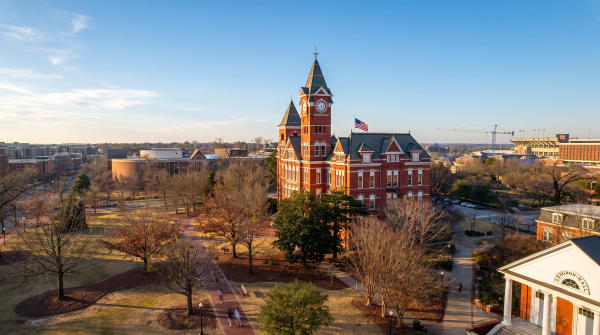
Auburn / Opelika
3 communities
Auburn University charm, RTJ golf, and Alabama's best tax breaks for retirees — Discover why retirees are choosing Auburn/Opelika

Birmingham Metro
1 community
Alabama's largest metro, world-class UAB medicine & Appalachian foothills — See why retirees are choosing Birmingham Metro
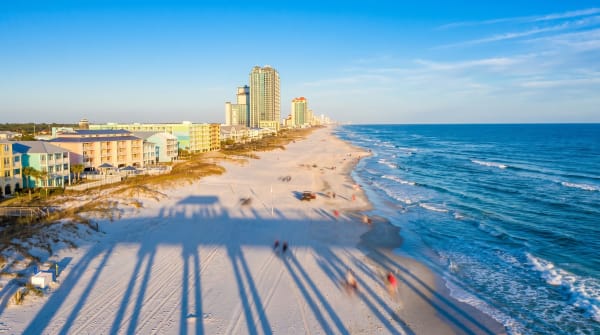
Gulf Shores / Baldwin County
0 communities
32 miles of sugar-white Gulf beaches, Eastern Shore charm & Alabama's most retiree-friendly tax rules — See why retirees are choosing Gulf Shores & Baldwin County
Taxes for retirees in Alabama
Alabama is one of the most tax-friendly states in the country for retirees, and this is usually the section people read first. Social Security benefits are fully exempt from state income tax regardless of income level. Traditional defined-benefit pensions (military, federal, state-employee, teacher, and most private-sector plans) are also fully exempt. Where Alabama does take a bite is on 401(k) and traditional IRA withdrawals, which are taxed as ordinary income at rates from 2% to 5%. There's a meaningful softener: residents 65 and older can exclude the first $6,000 of that retirement-account income per person in 2025, and starting January 1, 2026 that exemption doubles to $12,000 per person, a real break for the accounts most retirees actually draw down. Qualified Roth IRA and Roth 401(k) distributions aren't taxed by Alabama.
Property taxes are where Alabama really stands apart. The statewide effective rate sits around 0.38%, among the very lowest in the nation, and it gets better at 65: every Alabama homeowner 65 or older qualifies for the H-4 homestead exemption, which wipes out the entire state portion of property tax on a primary residence with no income test. Seniors with combined taxable income under $12,000 can qualify for H-3, which eliminates state and county property tax entirely. On a median-priced Alabama home, the annual property tax bill often lands in the low hundreds, a number that reshapes what fixed-income living actually costs.
Alabama has no estate tax and no inheritance tax, so what you build can pass to your family without a state-level hit. Sales tax is the one place the state claws back some revenue. The state rate is 4%, but local surtaxes push the combined rate above 9% in many areas and as high as 11% in a few. Run the specifics with a tax advisor before you move; county-level property tax rules and the H-2/H-3/H-4 filing process vary by county and require an application, not automatic enrollment.
Alabama climate & weather
Alabama has a humid subtropical climate: hot, sticky summers and short, mild winters. From June through September, expect highs in the 90s with high humidity and regular afternoon thunderstorms. The reward is a long, gentle shoulder season and winters that rarely turn harsh. North Alabama, around Huntsville and Birmingham, sees cooler nights, occasional frost, and a real (if brief) autumn; the Gulf Coast around Fairhope and Gulf Shores stays warmer and more temperate year-round.
Two weather realities deserve honest weight before you buy. First, the Gulf Coast (Baldwin and Mobile counties) sits squarely in hurricane territory from June to November; Hurricane Sally in 2020 is the recent benchmark. Insurers price that risk aggressively (more on that in Cost of Living). Second, most of the state sits in "Dixie Alley," a tornado and severe-hail corridor running from Tuscaloosa through Birmingham to Huntsville, with peak activity in spring. Inland areas escape storm surge but still pay for tornado and hail exposure through their insurance premiums. None of this is a dealbreaker. It's what you weigh against the mild winters and the tax bill.
Cost of living in Alabama
Alabama consistently ranks as one of the most affordable states in the country. The Bureau of Economic Analysis puts the statewide cost index at about 88.8, roughly 11% below the national baseline, and MERIC's 2026 index ranks Alabama the second-lowest cost-of-living state in the country, behind only Oklahoma.
Read moreShow less
Housing is the headline. Zillow pegs the average Alabama home value around $241,500 as of mid-2026, well under the national average and a fraction of what you'd pay in Florida or the Carolinas. The range inside the state is enormous: Orange Beach medians run around $725K, Fairhope around $649K, Gulf Shores in the low $500Ks, while Birmingham lists around $147K, Montgomery around $200K, Mobile around $246K, and Huntsville around $281K. Stack the country-low property taxes on top and the cost of owning a home is hard to beat almost anywhere else.
Everyday costs run below average too. Groceries and services come in cheaper than the national norm, utilities average around $439 per month, and rents statewide sit roughly 38% below the national average per BEA data.
Retiree-specific reality check: healthcare access is solid in the metros. UAB in Birmingham is a nationally regarded academic medical center, and Huntsville and Mobile offer strong regional care. In rural stretches it thins out, so proximity to a good hospital deserves real weight when comparing towns.
The honest caveat that doesn't make the brochures: homeowners insurance. Alabama sits in the top ten most expensive states for home insurance, averaging around $3,100 per year for a $300K dwelling, roughly $1,000 above the national norm, because Dixie Alley tornado risk and Gulf Coast hurricane exposure both get priced in. On the coast it gets serious: Gulf Shores averages about $4,159 per year, standard carriers exclude windstorm in Baldwin and Mobile counties (forcing homeowners into the state-run AIUA wind pool), named-storm deductibles run 2-5% of dwelling value, and separate flood insurance is effectively required near the water. Budget accordingly, especially if you're comparing a coastal condo to an inland patio home.
Pros of retiring in Alabama
- Property taxes among the lowest in the nation, with a statewide effective rate around 0.38%
- Social Security benefits fully exempt from state income tax
- Defined-benefit pensions (government, military, teacher, and most private) fully exempt
- H-4 homestead exemption wipes out the state portion of property tax at age 65 with no income test
- Retirement-account exemption doubles to $12,000 per person in 2026
- No estate tax and no inheritance tax
- Overall cost of living roughly 11% below the national average. MERIC ranks Alabama 2nd lowest COL state in 2026
- Median home values around $241,500 statewide, well below the national average
- Gulf Coast beaches and bayfront towns like Fairhope, Daphne, and Gulf Shores
- Mild, short winters with a long warm season
- Huntsville's fast-growing, tech-driven economy means newer housing stock and strong amenities
- UAB in Birmingham provides nationally recognized healthcare
- Lake living at Lake Martin and a relaxed, friendly pace
- Strong value versus Florida, the Carolinas, and Arizona for beach-adjacent retirement
Things to consider
- Hot, humid summers from June through September, with regular afternoon thunderstorms
- Hurricane exposure along the Gulf Coast. Baldwin and Mobile counties require AIUA wind coverage and separate flood insurance
- Dixie Alley tornado and hail corridor runs through Tuscaloosa, Birmingham, and Huntsville
- Homeowners insurance averages roughly 40% above the national norm; coastal premiums often exceed $4,000 per year
- Healthcare access thins out in rural parts of the state
- Fewer large, amenity-packed master-planned 55+ communities than Florida or Arizona
- Limited public transit. A car is a necessity almost everywhere
- Gulf Coast and waterfront markets like Fairhope and Orange Beach carry a real price premium
- Combined state-plus-local sales tax runs above 9% in many areas and up to 11% in a few
- 401(k) and IRA withdrawals are taxed as ordinary income beyond the age-65 exemption
55+ communities in Alabama: common questions
How many 55+ communities are in Alabama?
There are 4 active adult and 55+ communities in Alabama featured on Explore55Plus, with real photos, pricing, amenities, and resident insights for each.
How much do homes in 55+ communities in Alabama cost?
Homes in retirement and active adult communities in Alabama range from $300K to $1M, depending on the community, home type, and whether it's a new build or resale.
Are all 55+ communities in Alabama age-restricted?
No. Of the 4 communities in Alabama, 3 are age-restricted (typically one resident 55+) and 1 is open to all ages — so you can choose either an age-restricted or an all-ages active adult community.
Are there new-construction 55+ communities in Alabama?
Yes — 3 of the 4 communities in Alabama have new-construction homes available, alongside resale options in established neighborhoods.